Saturday, January 23, 2016

100 years ago, Americans talked about Catholics the way they talk about Muslims today


Updated by German Lopez on December 9, 2015, 3:00 p.m. ET @germanrlopez german.lopez@vox.com


About a century ago, millions of Americans feared that members of a religious group were amassing an arsenal of weapons for a secret, preplanned takeover of the United States.

The feared religious group was not Muslims. It was, as the Los Angeles Times's Matt Pearce wrote in a great new piece on Wednesday, Catholics:

Hatred had become big business in southwestern Missouri, and its name was the Menace, a weekly anti-Catholic newspaper whose headlines screamed to readers around the nation about predatory priests, women enslaved in convents and a dangerous Roman Catholic plot to take over America.…

America's deep and widespread skepticism of Catholics is a faint memory in today's post-Sept. 11 world. But as some conservative politicians call for limits on Muslim immigration and raise questions about whether Muslims are more loyal to Islamic law than American law, the story of Aurora's long-ago newspaper is a reminder of a long history of American religious intolerance.

Today, there are calls for federal surveillance of mosques in the name of preventing terrorist attacks; a century ago, it was state laws that allowed the warrantless search of convents and churches in search of supposedly trapped women and purported secret Catholic weapons caches.

This may seem absurd today, but there was a real fear among Protestant Americans back then that Catholics were planning to take over the country. As Pearce reported, the fears led to serious violence: Lynch mobs killed Catholic Italians, arsonists burned down Catholic churches, and there were anti-Catholic riots. It was a similar sentiment to the kind of Islamophobia today that's led many Americans to call for shutting down mosques, forcing Muslims to register in a national database, and even banning Islam.

The point of the comparison is not to say that the US faces the same problems today as it did a century ago, or that the discrimination toward Catholics back then and Muslims today is exactly the same. But when looking back at the history of the US, it's easy to see a pattern of consistent xenophobia and fears of outsiders.

Xenophobia makes a regular appearance in US history

In response to terrorist attacks in Paris and San Bernardino, much of the conversation has focused on refugees and immigration. This conversation has been tinged with xenophobia toward Muslims — with many Republican presidential candidates going as far as saying the US should ban Muslim refugees, people from Muslim-dominated countries, or Muslims altogether.

But this sort of rhetoric is not new to the US. As the Pew Research Center found, Americans have generally opposed taking in refugees even as they went through abhorrent, well-known crises. (Vox's Dara Lind noted that America even rejected some Jewish refugees fleeing Nazi Germany.)

Americans have regularly opposed refugees from other countries. Pew Research Center

Xenophobia has fueled other policies, too. In the late 19th century, the US passed the Chinese Exclusion Act to stop the flow of Chinese laborers into the US. During World War II, the US put Japanese Americans in internment camps after the country declared war on Japan. Throughout the war on drugs, lawmakers have regularly tapped into xenophobic sentiments to prohibit certain drugs — such as when San Francisco banned opium smoking that was perceived as popular among Chinese immigrants, and when prohibitionists built up opposition to marijuana by fearmongering about its use among Mexican immigrants.

Throughout all of these periods and policies, the public and lawmakers cited genuine policy interests: national security, keeping American laborers competitive in the job market, and preventing drug abuse. But underlying such policy stances were obvious signs that Americans were simply scared of foreigners who weren't like them.

By and large, we tend to recognize the underlying xenophobia today, and that the policies it produced were wrong, bigoted, and self-destructive.

As Islamophobia rears its ugly head in the US again, it's worth thinking about how we now look back on those moments of American history — and whether we're making the same mistakes again.

Above is from:  http://www.vox.com/2015/12/9/9880942/islamophobia-catholics

Thursday, January 21, 2016

Pope Changes Church Rules, Opens Foot-Washing Rite to Women

  • By nicole winfield, associated press

VATICAN CITY — Jan 21, 2016, 3:24 PM ET

Pope Francis has changed church regulations to explicitly allow women and girls to participate in the Easter Week foot-washing ritual, after having shocked many Catholics by performing the rite on women and Muslims just weeks after he was elected.

Proponents of women's ordination hailed Francis' decree, while traditionalist Catholics warned that it would weaken the church and lead to questions about the inviolability of the all-male priesthood.

Vatican rules for the Holy Thursday rite had long called for only men to participate. Popes past and many priests traditionally performed the ritual on 12 Catholic men, recalling Jesus' 12 apostles and further cementing the doctrine of an all-male priesthood.

Shortly after he was elected, Francis raised conservative eyebrows by performing the rite on men and women, Catholics as well as Muslims, at a juvenile detention facility in Rome.

He has continued to include men and women, young and old, sick and healthy and people of different faiths, traveling each year to encounter them to show his willingness to serve. It was a tradition he began as archbishop in Buenos Aires.

On Thursday, the Vatican published a decree from the Vatican's liturgy office introducing an "innovation" to the church's rules that better corresponds to Francis' way of doing things.

The decree said the rite can now be performed on anyone "chosen from among the people of God." It specifies that the group can include "men and women, and ideally young and old, healthy and sick, clerical, consecrated and lay."

Priests must make sure that those participating are instructed beforehand as to the significance of the gesture, the decree said. While the phrase "people of God" generally refers to baptized Christians, the decree also said that pastors should instruct "both the chosen faithful and others so that they may participate in the rite consciously actively and fruitfully." That could suggest that the rite could be open to non-Catholics as well.

In an accompanying letter, dated Dec. 20, 2014 but released Thursday, Francis wrote to the head of the liturgy office saying he wanted to change the current rules "to fully express the significance of Jesus' gesture ... his giving of himself to the end for the salvation of the world and his unending charity."

The Women's Ordination Conference, a group that has long advocated for female priests, celebrated the decree as a sign that "change is possible." But it noted that Francis' wishes clearly met resistance within the Vatican, given his letter requesting the change was dated more than a year ago.

Cardinal Robert Sarah, head of the liturgy office, is a staunch conservative.

"Our prayer during this Year of Mercy is that the inclusion of women in the church not stop at our feet, but will be one of many signs to include women fully in the institutional church," the group said in a statement.

The traditionalist blog Rorate Caeli, meanwhile, warned that the accommodation could lead to questions about the inviolability of the all-male priesthood and bring the Catholic Church the way of the Anglican Communion, which has been badly divided over allowing female priests and bishops and blessing same-sex unions.

"What is most tragic is to see the very same impulses that imploded Anglicanism imposed on Latin Church decades later," Rorate Caeli said ——

Above is from:  http://abcnews.go.com/Health/wireStory/pope-church-law-gender-friendly-pre-easter-rite-36419672

Pro-lifers plow ahead with plans to march in D.C.


By Matthew Gambino

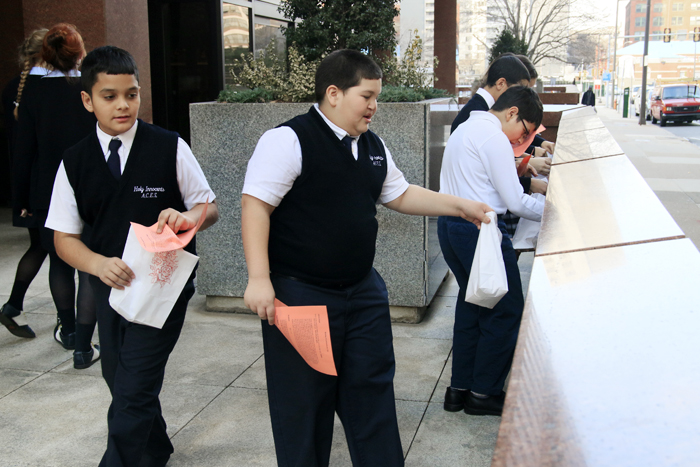
Students of Holy Innocents School in Philadelphia, along with students of John W. Hallahan Catholic Girls' High School, place luminaries for life at the Archdiocesan Pastoral Center along a wall facing 17th Street in Philadelphia. (Sarah Webb)

Students of Holy Innocents School in Philadelphia, along with students of John W. Hallahan Catholic Girls’ High School, place luminaries for life at the Archdiocesan Pastoral Center along a wall facing 17th Street in Philadelphia. (Sarah Webb)

Despite the foot of snow expected to fall on Philadelphia Friday night into Saturday, and up to two feet anticipated for the Washington, D.C. area, the annual March for Life in the nation’s capital has not been postponed or cancelled.

“The March for Life will go on no matter the weather,” the march’s official website declared Thursday afternoon. “Despite the winter storm prediction, the March for Life will not be cancelled.”

The annual public protest observes the Jan. 22, 1973 Supreme Court decision that legalized abortion in the United States.

Marchers from across the country gather each year for a rally near the Washington Monument then march from there past the U.S. Capitol and on to the Supreme Court building.

Auxiliary Bishop of Philadelphia John J. McIntyre will lead the Philadelphia contingent traveling by bus, train and car to Washington. Hundreds of parishioners, clergy and religious from the Philadelphia Archdiocese normally travel each year for the march.

Dubbed Winter Storm Jonas, some 74 million Americans from Nebraska to New York City will be affected by blizzard conditions of the mammoth storm.

Some diocesan groups including Cincinnati, St. Louis and in Virginia, Indiana and Michigan have already cancelled their trips to Washington due to the storm. While the Philadelphia Archdiocese indicated no change in plans, as of Thursday several parish and school groups had cancelled their participation.

The National Weather Service has issued a blizzard warning (upgraded from a watch) for the Baltimore/Washington/Northern Virginia area beginning 3 p.m. Friday – about the time the March for Life usually ends.

The bulletin said heavy snow – 24 inches in Washington and 30 inches in the western suburbs — will develop late Friday afternoon and continue through Saturday night in that region, with “potential life threatening conditions expected Friday night through Saturday.”

The snow driven by sustained winds of 25 to 35 m.p.h., with gusts up to 50 m.p.h., “will cause dangerous conditions and will be a threat to life and property,” the weather service said. “Travel is expected to be severely limited if not impossible during the height of the storm Friday night and Saturday. Visibility will be reduced to near zero at times in whiteout conditions.”

Philadelphians and all participants are invited to a vigil Mass at the Basilica of the National Shrine of the Immaculate Conception in Washington on Thursday night, Jan. 21, from 5:30 to 7:30 p.m., with New York Cardinal Timothy Dolan as celebrant.

Bishop McIntyre will celebrate Mass at the shrine Friday morning at 10 a.m. for the approximately 3,000 anticipated faithful from the Archdiocese of Philadelphia attending the march.

A rally preceding the march will begin at 12 noon with speeches on the grounds of the Washington Monument near the corner of 15th Street and Constitution Avenue. At 1 p.m. marchers will start out from Constitution Avenue between 15th and 17th Streets.

Participants from the Philadelphia Archdiocese will meet on the corner of Constitution Avenue and 15th Street. They are invited to walk behind the Archdiocese of Philadelphia’s banner, carried by seminarians from St. Charles Borromeo Seminary.

The march ends at approximately 3 p.m. at the Supreme Court, located about three blocks from Amtrak’s Union Station in Washington.

In addition to the rally and march, organizers will present their inaugural March for Life Achievement Award to Chester County Republican U.S. Rep. Joe Pitts, who is retiring after 20 years in Congress.

Monday, January 18, 2016

What does the Pope’s synagogue visit mean for Jews and Christians?


Pope Francis’s visit to a synagogue in Rome comes amid questions about the shifting status of Jewish-Catholic relations.

Christian Science Monitor

By Ben Thompson January 17, 2016 2:29 PM

Pope Francis visited the Great Synagogue of Rome Sunday, becoming only the third Catholic leader in modern times to visit the Jewish house of prayer.

Francis spoke at the synagogue in an effort to demonstrate interfaith solidarity in the wake of recent religiously motivated violence around the world, and to condemn anti-Semitism. The Pope’s remarks were met with a generally positive response, according to the Associated Press.

"The hatred that comes from racism and bias or worse which uses God's name or words to kill deserves our contempt and our firm condemnation," said Ruth Dureghello, president of the Rome's Jewish community, according to the AP.

Francis’s visit followed previous Great Synagogue papal appearances by Pope John Paul II in 1986 and Pope Benedict XVI in 2010, both made in times of strained relations between the two religions.

Rome’s chief rabbi, Riccardo Di Segni, hosted Francis’s visit and was also present when Benedict attended. Before the Sunday event, Rabbi Di Segni expressed hope that the visit could accentuate the friendship between Jews and Christians while also criticizing recent moves by the Vatican, saying they "cannot be so appreciated by the Jewish community."

While relations between Jews and Catholics are relatively calm now, some believe the Vatican has not acknowledged Israel properly while giving Palestine recognition.

In 2015, the Catholic Church signed a treaty recognizing a “State of Palestine.” And Francis had previously visited the West Bank prior to Israel when traveling through the region, as well as possibly having likened Palestinian president Mahmoud Abbas to an “angel of peace.”

Despite these tensions, the Vatican released an update on the status of Catholic-Jewish relations last month, 50 years after the Church’s first declaration on relations with non-Christian religions – the Nostra aetate – was published. The December reflection pertained to the “special” dialogue between Jews and Christians and where the Catholic Church hopes to take it.

The release also made new points that the Church should not actively try to convert Jews, and acknowledged that the two religions share a unique historical and theological connection.

"This document is very significant," Rabbi David Rosen of the American Jewish Committee told the AP.

The Pope’s Sunday visit also included an acknowledgment of Holocaust survivors and Francis’s repetition of John Paul’s assertion that Jews are Christians’ “elder brothers” in the family of God.

But the top Catholic’s main message was the condemnation of recent violence perpetrated by and directed at religious people.

"Violence of man against man is in contradiction to every religion that merits the name, in particular the three monotheistic religions," Francis said, according to the AP.

"Every human being, as a creature of God, is our brother regardless of his origins or religious belief,”  he said

Above is from:  http://news.yahoo.com/does-pope-synagogue-visit-mean-jews-christians-192928543.html

Sunday, January 17, 2016

Bishop Finn’s new assignment

January 15, 2016 8:00 am  •  By Erin Andersen | Lincoln Journal Star

Erin Andersen | Lincoln Journal Star


For the first time in 13 years, Lincoln’s Catholic Diocese will participate in the next sex abuse audit conducted by the United States Confere…

A Catholic bishop who was the first American priest convicted of not notifying police of suspected child abuse in a timely manner is now the chaplain at a Lincoln convent.

But Lincoln's bishop said Robert Finn paid for his mistake by completing two years of probation and deserves mercy.

Finn became chaplain of Lincoln's School Sisters of Christ the King convent in December after serving as bishop of the Diocese of Kansas City-St. Joseph for 10 years.

He cited personal reasons when he resigned as a bishop in April in the aftermath of a child pornography scandal involving one of his priests, Father Shawn Ratigan, and a subsequent Vatican investigation into Finn's effectiveness as a leader.

As chaplain for the School Sisters of Christ the King, Finn celebrates Mass, hears confessions and serves as spiritual adviser to the more than 30 nuns who live in the convent. He succeeds Monsignor Myron Pleskac, who died Jan. 2.

Bishop James D. Conley of the Catholic Diocese of Lincoln said Finn has been well received in Lincoln.

The School Sisters of Christ the King nuns serve as principals and teachers in seven Lincoln diocese schools.

Diocese spokesman JD Flynn noted that despite the controversy surrounding Finn's time in Kansas City, he never was accused or even suspected of any sexual impropriety. Rather, he said, Finn's offense was an administrative mistake, in that he failed to notify police immediately of Ratigan’s behavior and tried to handle matters within the diocese.

Finn was the first American priest to even be indicted for failing to report suspected child abuse to police “in a timely manner.”

He learned in December 2010 that Ratigan had child pornography on his computer involving children in the Kansas City diocese. According to reports, Finn immediately removed Ratigan from the school and ordered him not to have contact with children.

But the photos were not reported to police until five months later, and by that time, Ratigan had taken more photos of another young girl in the diocese. Ultimately, he was sentenced to 50 years in prison.

Finn and the diocese were each indicted on two misdemeanor counts of failing to report the abuse. A judge found Finn guilty of one count and sentenced him to two years on probation. The diocese paid a $1.1 million civil fine for violating the terms of a 2008 civil settlement regarding the Kansas City diocese and a history of child sex abuse.

Finn declined a request for an interview.

Citing the Catholic Year of Mercy, as declared by Pope Francis, the Lincoln diocese sees Finn as a priest who should be allowed to move on.

“It is a grace to welcome Bishop Finn to our diocese, to continue his priestly ministry as chaplain to the School Sisters of Christ the King," Conley said in a written statement. "Priests and the faithful of our diocese have told me how glad they are to have him here. Bishop Finn has been a longtime friend to the School Sisters -- and in God’s mercy, he arrived just as their beloved chaplain passed away.

"Of course, Bishop Finn has faced legal issues related to administrative decisions, he’s addressed them appropriately, and they’ve been resolved. The faithful of our diocese can be confident that his ministry as a chaplain to the School Sisters of Christ will be a grace for all of us, and a witness to God’s enduring mercy."

Conley consulted with a number of ecclesiastical officials before assigning Finn to the convent, Flynn said. The appointment was announced in both the Lincoln and Kansas City diocese newspapers in December, and Finn had to pass a customary background check and complete child protection training before the Lincoln appointment.

“We have zero tolerance for crimes against children,” he added, noting that Conley has reversed former Lincoln Bishop Fabian Bruskewitz' longstanding refusal to take part in the U.S. Conference of Catholic Bishops' clergy sex abuse audit.

“It was not that he didn’t report it," Flynn said of Finn's involvement. "It was how and when … The way he reported it didn’t fulfill the requirements of the law.”

But in Kansas City, opinions are markedly divided.

Finn’s critics say he took part in a massive cover-up, perpetuating the victimization of Ratigan’s victims through drawn-out and extremely costly legal proceedings.

Supporters paint a picture of a leader whose conservative ideas ruffled feathers among the diocese’s entrenched bureaucracy from the start. Ratigan’s offenses exacerbated Finn’s status as the diocese’s “low-hanging fruit,” as Frank Kessler wrote in an article for Crisis Magazine in May.

Some accused Kansas City Prosecuting Attorney Jean Peters Baker of making Finn a political scapegoat, which she denied.

"No one is above the law, no matter our position or title,” Baker wrote in a letter to members of Christ the King Parish in Kansas City, Missouri.

All of that is in the past, Flynn said, questioning the motivation of those who continue to make an issue of Finn’s history.

“It doesn’t strike me as particularly Christian to search out a person who made a mistake and continue to hound him about it,” Flynn said

Above is from:  http://journalstar.com/news/local/embattled-k-c-bishop-starts-anew-in-lincoln-convent/article_1e73ef3e-f2fe-5e41-b3e0-2d90c9f1552f.html

.

Letter, 1/17: Diocese deceiving flock over Bishop

2016-01-16T23:55:00Z Letter, 1/17: Diocese deceiving flock over Bishop JournalStar.com

14 hours ago

Nebraska Catholic officials are deceiving their flock about Bishop Robert Finn, the only prelate in the US to be criminally convicted for refusing to report child sex crimes to police. Finn now works in Nebraska ("Embattled K.C. bishop starts anew in Lincoln convent," Jan. 15).

It’s dreadfully disingenuous to claim, as Bishop James Conley and one of his spokesmen, JD Flynn, are doing, that Finn's offense was an administrative mistake. It was not. It was a crime. There was a trial. Finn was found guilty. He was penalized.

It’s also disingenuous to claim, as Conley and Flynn are doing, that Finn failed to notify police immediately of a now-convicted priest’s behavior. Finn never notified the police. Months later, one of Finn’s underlings called the police.

And, in fact, Finn kept information and suspicions about these heinous crimes from police for months.

Finn, in fact, did not “fail.” Time and time again, Finn made deliberate, self-serving decisions to protect himself, his reputation and his priest, instead of protecting his flock.

Failure suggests a good faith effort that went awry. Had Finn tried to call the police but misdialed, that would have been a failure. Had he mailed evidence to police but forgot to put a stamp on the envelope, that would have been a failure.

But Finn did not “fail” to call the police. He knowingly refused to do so, for months, and during those months, more child sex crimes were committed, more kids were hurt, more families were deceived and devastated.

We hope those who saw, suspected or suffered clergy sex crimes or cover ups during Finn’s tenure in Kansas City will call police, expose wrongdoers and protect kids and we hope Nebraska Catholic employee and parishioners will denounce Lincoln’s bishop for this irresponsible move.

Barbara Dorris, Outreach Director for SNAP, Survivor Network of those Abused by Priests, St. Louis, MO

Ms. Dorris’ letter is from:  http://journalstar.com/news/opinion/mailbag/letter-diocese-deceiving-flock-over-bishop/article_cc0c80e6-d918-5653-a9d3-9e1203c96093.html