Showing posts with label Cardinal Burke. Show all posts

Tuesday, April 21, 2015

Cardinal Burke Responds to Recent Criticisms | Daily News | NCRegister.com


by RICCARDO CASCIOLI 04/17/2015 Comments (40)

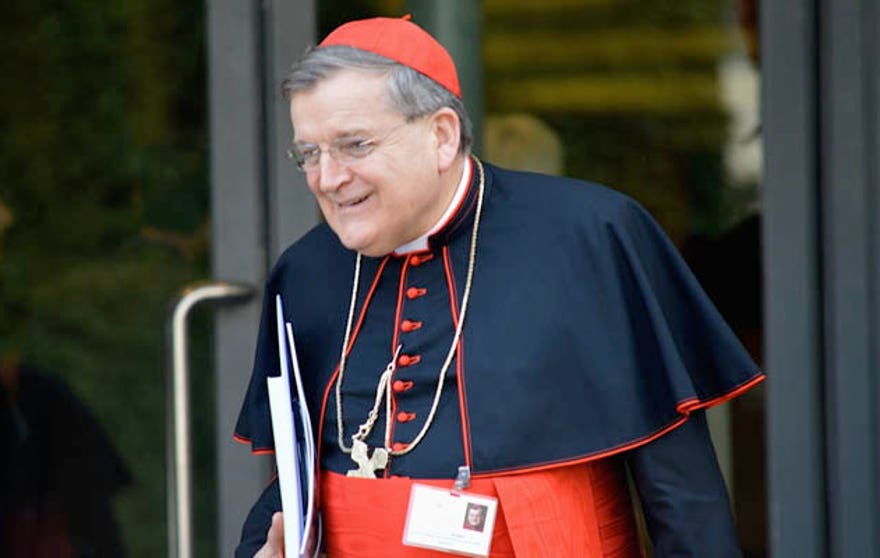
Joaquín Peiró Pérez/CNA

Cardinal Raymond Burke

– Joaquín Peiró Pérez/CNA

Cardinal Raymond Leo Burke, 66, is troubled by the negative campaign that has been waged against him. Ordained a bishop by Pope John Paul II in 1995, the respected expert in canon law was called to Rome by Pope Benedict XVI in 2008 as prefect of the Supreme Tribunal of the Apostolic Signatura before being appointed cardinal in 2010.

In recent months, critics have described him as an “ultraconservative fanatic,” “anti-Conciliar,” “in conspiracy against the Pope” and even ready for a schism should the upcoming family synod open up unwelcome changes.

The criticism has been so defamatory that in Italy several bishops have even refused to host his lectures in their dioceses. Where he has been allowed to give a conference — as recently in some cities in the north of Italy — there are invariably priests who oppose him and accuse him of spreading propaganda against the Pope.

“It’s total nonsense; I don’t understand this attitude. I have never said a single word against the Pope; I strive only to serve the truth, a task that we all have. I have always seen my talks and my activities as a support to the Petrine ministry. The people who know me well can witness to the fact I am not anti-papal. On the contrary, I have always been extremely loyal and wanted to serve the Holy Father, as I am doing now.”

Indeed, meeting him in his apartment, a stone’s throw from St. Peter’s Square, with his friendly manner and spontaneity, Cardinal Burke bears no resemblance to that hard defender of “cold doctrine” as he is described by mainstream media outlets.

Cardinal Burke, in the debate that preceded and followed the first synod on the family, some of your statements did sound like criticisms of the Pope, or at least that is how they were interpreted. For example, quite a stir was caused by your recent remark, “I will resist; I’ll resist,” as a response to a possible decision of the Pope to grant Communion to the divorced and remarried.

That comment was misrepresented, and there was no reference to Pope Francis. I believe that because I have always spoken very clearly on the issue of marriage and the family, there are people who want to undermine what I say by depicting me as an enemy of the Pope or even ready for a schism by using that answer I gave in an interview with a French television channel.

How should we interpret that answer?

Quite simply. The journalist asked me what I would do if, hypothetically, not referring to Pope Francis, a pontiff were to make decisions contrary to the Church’s doctrine and practice. I replied I should resist, because we are all in the service of the truth, starting with the Pope. The Church is not a political body, in the sense of power. The power is Jesus Christ and his Gospel. Therefore, I replied I would resist, and it would not be the first time that this has happened in the Church. There have been several moments in history where someone had to stand up to the pope, beginning with St. Paul against St. Peter, in the matter of Judaizers who wanted to impose circumcision on the converted Greeks. In my case, I am not resisting Pope Francis at all because he hasn’t done anything against the doctrine. Nor do I see myself in a fight against the Pope, as they try to depict me. I’m not pursuing the interests of a group or party. I am simply trying, as a cardinal, to be a teacher of the faith.

Another criticism made against you is your alleged passion for “lace,” a comment used in a demeaning way to criticize your preferred clerical and liturgical vestments as something that the Pope cannot endure.

The Pope has never made me aware that he disapproves of the way I dress, which, anyway, has always been within norms of the Church. I celebrate the liturgy also in the extraordinary form of the Roman rite, and there are vestments for this which do not exist for the celebration of the ordinary form, but I always wear what is required for the rite that I am celebrating. I am not making a political statement against the Pope’s way of dressing. It has to be said that every pope has his own style, but he does not impose this on all the other bishops. So I don’t understand why this should be a cause for controversy.

But newspapers often use a photo of you wearing a hat clearly out of date.

Yes, I know, but it’s just incredible. I can explain: That photo was spread around after Il Foglio published it alongside the interview I did at the time of the synod. The interview had been done well, but, unfortunately, they chose a photo that had nothing to do with it, which I regret, because, in this way, they gave the mistaken impression of a person who lives in the past. The truth is that, after being named cardinal, I was invited to a diocese in the south of Italy for a conference on the liturgy. For the occasion, the organizer decided to give me as a gift an old-fashioned cardinal’s hat. I have no idea where he got it from. I held it in my hand and obviously had no intention of wearing it regularly, but he asked me to put it on to take at least one photo. This was the only time I put that hat on my head, but, unfortunately, that picture has been published all over the world, and some use it to give the impression that I go around like that. But I’ve never worn it, not even for a ceremony.

You have also been named as the inspiration if not the promoter of the “Petition to Pope Francis for the Family,” which has been circulated to collect signatures by a number of traditionalist websites.

I did sign that petition, but it is not my initiative or my idea. Nor did I write or collaborate in drafting the text. Anyone who says otherwise is affirming something false. As far as I know, it is an initiative by laypeople. I was shown the text, and I signed it, as have many other cardinals.

Another of the charges against you is that you are against the Second Vatican Council.

These labels are easy to apply, but there is no basis in reality. All my theological education in the major seminary was based on the documents of Vatican II, and I am still trying to study these documents more deeply. I’m not at all opposed to the Council, and if one reads my writings, he will find that I quote the documents of Vatican II many times. What I don’t agree with is the so-called “spirit of the Council,” which is not faithful to the Council texts but purports to create something totally new, a new church that has nothing to do with all the so-called aberrations of the past. On this matter, I wholeheartedly follow Pope Benedict XVI’s enlightening presentation to the Roman Curia for Christmas 2005: It is the famous discourse in which he explains the correct hermeneutic, which is that of reform in continuity, as opposed to the hermeneutic of rupture in discontinuity that many sectors promote. Pope Benedict XVI’s presentation is brilliant and explains everything. Many things that happened after the Council and are attributed to the Council have nothing to do with the Council. This is the plain truth.

Did Pope Francis “punish” you by removing you from the Apostolic Signatura and entrusting you with the patronage of the Sovereign Military Order of Malta?

In an interview with the Argentine newspaper La Nacion, the Pope already answered this question by explaining the reasons for his decision. This already says everything, and it is not up to me to comment. I can only say, without revealing any confidential information, that the Pope has never told me or given me the impression that there was anything he wanted to punish me for.

Perhaps your “reputation” has to do with what Cardinal Walter Kasper called the “synod battle,” which also seems to grow in intensity as we get closer to the ordinary synod this coming October. At what stage are we now?

I would say that there is now a much more extensive discussion on the topics covered by the synod, and this is a good thing. There is a greater number of cardinals, bishops and laypeople who are intervening, and this is very positive. Therefore, I don’t understand all the fuss last year made over the book Remaining in the Truth of Christ, to which I contributed, along with four other cardinals and four specialists on marriage.

That was when the theory of a conspiracy against the Pope was born, a view echoed recently by the well-known Italian historian Alberto Melloni, co-author of a famous history of the Vatican Council II that pushes for a progressive interpretation of the Council. Melloni wrote an article for the most popular Italian newspaper Corriere della Sera, blaming the five cardinals of a conspiracy against the Pope.

It is simply absurd. How can you possibly accuse of plotting against the Pope those who uphold what the Church has always taught and practiced on marriage and Communion? The book was certainly written as an aid for the synod to answer Cardinal Kasper’s thesis. But it is not polemical, it is a presentation completely faithful to the Tradition, and it is also of the highest scholarly quality possible. I am absolutely disposed to receive criticism on the content, but to say we conspired against the Pope is unacceptable.

Who is behind this witch hunt?

I do not have any direct information, but there is definitely a group that wants to impose on the Church not only Kasper’s thesis on Communion for the divorced and remarried, or for those in irregular situations, but also other positions related to the themes of the synod. I think, for instance, of the idea of identifying the positive aspects of extramarital or homosexual relationships. It is evident there are forces pushing in this direction, and this is the reason why they want to discredit those of us who are trying to defend the Church’s teaching. I have nothing personal against Cardinal Kasper; for me, the question is only to proclaim the Church’s teaching, which in this case is tied to words spoken by the Lord.

Looking at some of the themes that emerged strongly in the synod, there is talk again about a “gay lobby.”

I can’t precisely identify it, but I see more and more that there is a force moving in this direction. I can see people either consciously or subconsciously driving a homosexual agenda. How it’s organized, I don’t know, but it is evident there is a force of this nature. At the synod, we said that homosexuality had nothing to do with the family; rather, a synod should be convoked on the subject if we wanted to speak about this theme. And, instead, we found in the relatio post disceptationem this theme which had not been discussed by the fathers.

One of the theological arguments that is frequently repeated to justify Cardinal Kasper is that of the “development of doctrine.” It isn’t change, but a deeper understanding that can lead to new practice.

Here, there is a big misunderstanding. The development of doctrine, as, for example, Blessed Cardinal [John Henry] Newman put it or other good theologians, means a deepening in appreciation in the knowledge of a doctrine, not the change of doctrine. Development in no case leads to change. An example of this is Pope Benedict’s post-synodal exhortation on the Eucharist, Sacramentum Caritatis, where he presents the development of the knowledge of the real presence of Jesus in the Eucharist, also expressed in Eucharistic adoration. There have in fact been some who were contrary to Eucharistic adoration, because the Eucharist is to be received within us. But Benedict XVI explained — also citing St. Augustine — that if it is true that the Lord gives us himself in the Eucharist to be consumed, it is also true that you cannot recognize this reality of Jesus’ presence under the Eucharistic species without worshipping these species. This is an example of the development of doctrine, but it is not the case that the doctrine on the presence of Jesus in the Eucharist changed.

One of the recurring themes in the controversy on the synod is the alleged opposition between doctrine and practice, doctrine and mercy. The Pope often insists on the pharisaic attitude of those who use doctrine to keep out love.

I think you have to distinguish between what the Pope says on certain occasions and those who affirm an opposition between doctrine and practice. The Church can never allow a contrast between doctrine and practice, because we live the truth that Christ communicates to us in his holy Church, and the truth is never something cold. It is the truth that opens to us a space for love; to love, really, you have to respect the truth of the person and of the person in the particular situations in which you find him or her. Thus, creating a kind of contrast between doctrine and practice does not reflect the reality of our faith. One who supports the thesis of Cardinal Kasper — a change of discipline that does not touch doctrine — should explain how this is possible. If the Church allows Communion for a person who is bound by marriage but who is living with another person in a matrimonial relationship, that is in a state of adultery: How can the Church allow this and maintain at the same time that marriage is indissoluble? The contrast between doctrine and practice is a false contrast that we must reject.

But it is also true that you can use doctrine without love.

Absolutely, and this is what the Pope is condemning, the use of doctrine or law to promote a personal agenda in order to dominate people. But this does not mean there is a problem with the doctrine and discipline; only there are people of ill will who commit abuses, for instance by interpreting the law in a way that harms people. Or they apply the law without love, insisting on the truth of a situation of a person but without love. Even when someone is in a state of grievous sin, we have to love that person and help him or her like Our Lord did with the adulteress and the Samaritan woman. He was very clear in announcing the state of their sin, but at the same time, he showed great love by inviting them to come out of this situation. This is not what the Pharisees did; instead, they showed cruel legalism: denouncing the violation of the law without offering any help to the person on how to turn away from sin so as to find peace again.

Riccardo Cascioli is editor of the popular Italian Catholic website Nuova Bussola Quotidiana,

where this interview originally appeared in Italian. Translated for the Register by Patricia Gooding Williams.

Cardinal Burke Responds to Recent Criticisms | Daily News | NCRegister.com

Saturday, March 28, 2015

Cardinal Raymond Burke: Gays, Remarried Catholics Are Just As Sinful As Murderers


When Pope Francis last year effectively demoted U.S. Cardinal Raymond Burke by moving him out of a senior post in the Vatican to a largely ceremonial role as head of a Rome-based Catholic charity, it was viewed as a way to sideline one of the pontiff’s most outspoken critics on the right.

But the move seems to have left Burke free to air his conservative — and pointed — views on efforts to change church practices, not that he was ever terribly hesitant about speaking his mind.

Now the American churchman has spoken out again, telling an interviewer that gay couples and divorced and remarried Catholics who are trying to live good and faithful lives are still like “the person who murders someone and yet is kind to other people.”

“If you are living publicly in a state of mortal sin there isn’t any good act that you can perform that justifies that situation: the person remains in grave sin,” Burke said in an interview with LifeSiteNews, a U.S.-based web service focused on battling abortion and promoting other conservative causes.

“And to give the impression that somehow there’s something good about living in a state of grave sin is simply contrary to what the (Catholic) Church has always and everywhere taught,” said Burke, who spoke to LifeSiteNews in Rome.

Asked if being “kind” and “generous” and “dedicated” is enough, Burke replied: “Of course it’s not. It’s like the person who murders someone and yet is kind to other people.”

The lengthy interview was published on Tuesday (March 24).

On the surface, Burke’s comments break little theological ground; the church has always taught that sin is sin, and some sins are especially serious. For example, cohabitation, homosexual relations and adultery (which is how the Catholic Church views the relations of a couple who are divorced and remarried without annulling the first marriage) are viewed as mortal sins, as is murder.

But comparing those situations in any context is unusual, and certainly out of step with the pastoral tone that Francis has set in his papacy. Moreover, reformers argue that a murderer — or almost any other sinner — can go to confession, receive absolution, and take Communion in a state of grace. But there is no such option for a gay person or those who are divorced and remarried, except permanent celibacy.

The cardinal’s comments take on added weight in the context of the increasingly heated debate that Francis opened over how the church should respond to rapid changes in family life in the modern world.

The issues were heatedly debated at a global summit of bishops and cardinals at the Vatican last October, and the debates have continued as both sides jockey for position ahead of a follow-up synod this October. Those who back reforms in church practices and attitudes — especially toward gay couples and those who are divorced or cohabiting — are opposed by those who see any changes as tantamount to undermining doctrine.

During last fall’s synod, several high-ranking churchmen spoke about the lives of unmarried or remarried couples as having value that the church should recognize.

Austrian Cardinal Christoph Schoenborn, for example, repeatedly stressed that the church should “look at the person and not the sexual orientation.” He cited the case of a gay couple he knew in which one partner cared for the other through a long-term illness in a way that was “exemplary. Full stop.”

Similarly, Cardinal Reinhard Marx of Munich, a senior adviser to Francis, said that “one simply cannot say that a faithful homosexual relationship that has held for decades is nothing.”

“We just mustn’t lump things together and measure everything with the same yardstick, but must differentiate and take a closer look, which doesn’t mean that I endorse homosexuality as a whole,” he said.

But such language sounded alarm bells for traditionalists like Burke, who after the synod was named to the largely ceremonial post of patron of the Order of the Knights of Malta. In his earlier post in the Roman Curia, Burke was automatically included in the synod discussions; he will probably not take part in this fall’s meeting.

In this latest interview, he repeated his earlier claims that reformers were manipulating the synod discussions and waging a media campaign “to justify extra-marital sexual relations and sexual acts between persons of the same sex” that would undermine church teaching.

Burke, 66, has raised eyebrows, and made headlines, with previous comments. Earlier this year, he argued that the church has become too “feminized” and he blamed the introduction of altar girls more than 20 years ago for the decline in vocations to the church’s all-male priesthood.

The cardinal also blamed gay clergy for the church’s sexual abuse crisis, saying priests “who were feminized and confused about their own sexual identity” were the ones who molested children.

Cardinal Raymond Burke: Gays, Remarried Catholics Are Just As Sinful As Murderers

Tuesday, December 9, 2014

Pope Cautions Against Media Interpreting His Words


Both Pope Francis and his predecessor, Pope Emeritus Benedict XVI, have shared frank remarks with major newspapers, each going some way to clearing the air on their approach toward current issues.

In his latest interview published Sunday in the Argentine daily La Nacion, Pope Francis affirmed he wishes to relax rules on Catholic remarried divorcees to further integrate them into the church. He also dismissed accusations that he demoted an American cardinal and said he is planning on visiting Africa next year, with a possible trip to Argentina in 2016.

Speaking for 50 minutes to Argentine journalist Elisabeth Piqué at his St. Martha residence Dec. 4, he gives some clues to his thinking and approach to the papacy: first, that he doesn’t want to change as Pope but remain as he’s always been because to change at his age “would be to make a fool of yourself.”

Second, he welcomes resistance to his leadership as it’s “very healthy” to have things “out into the open.” And third, when it comes to the effect of criticism on him, he said God has bestowed on him “a healthy dose of unawareness. I just do what I have to do".

The last comment is coherent with what has been said of Pope Francis: that he pays little or no attention to what the media say and rarely reads newspapers. He alludes to this in the interview, saying “in general people don’t read about what is going on” and he urges people to read his actual words rather than media interpretations. ….

Read the entire article by clicking on the following:  Pope Cautions Against Media Interpreting His Words

Report: Popes Benedict, Francis at Odds Over 'Indissolubility' of Marriage


The German newspaper reported on Sunday that Benedict said he is trying to be "as quiet as possible" and insisted he has "very good contact" with Francis, dismissing talk of a rift as "complete nonsense."
But the Italian press quickly noted that his clear comments about Church teachings regarding marriage put him at odds with the Pope.
Benedict also said that he would have liked to be known after his resignation as "Father Benedict" to distinguish himself more clearly from the current pontiff.

He has been known as Emeritus Pope Benedict XVI since his retirement last year.
The Germany newspaper reported that Benedict made that disclosure during a recent visit, saying he would have preferred being addressed as "Padre Benedetto" but was too tired at the time to insist on that designation….

Click on the following to read all of the article:  Report: Popes Benedict, Francis at Odds Over 'Indissolubility' of Marriage

Pope Francis: Demotion of Burke not ‘punishment’ | Crux


“It is not true that I removed him because of how he had behaved in the synod,” Francis said.

The pontiff said that the move was part of a broader restructuring of the Vatican bureaucracy that had been decided well before the October 5-19 synod of bishops on the family. The reason he waited until after the synod to make it official, he said, was so that Burke could still participate in the meeting as the head of a Vatican department.

The comments came in an interview with the Argentinian daily La Nacion, and was conducted by veteran Rome writer Elisabetta

Read the rest of the article:  Pope Francis: Demotion of Burke not ‘punishment’ | Crux

Friday, December 5, 2014

Wisconsin native Cardinal Raymond Burke calls for 'new evangelization'


…..Burke bolstered that reputation at the recent Synod of Bishops on the Family in Rome, where he joined other conservatives in rejecting efforts to change teaching — and in some cases, just tone — on how the church responds to gay relationships, marriage, divorce and contraception.

In the wake of the synod, he has amplified his criticism, likening the church to a "rudderless ship" under the current pontiff in a recent interview.

Burke has been twice demoted since the former archbishop of Buenos Aires succeeded Pope Benedict in March 2013.

Removed from post

Last year, Francis removed Burke from an influential panel that helps select American bishops. Last month, Burke was removed from the curia, or Vatican bureaucracy, with his demotion from the Vatican court to the largely ceremonial position as patron of the Knights of Malta.

Vatican watchers have debated whether the moves were punitive or meant to silence Burke.

Author and longtime Vatican journalist John Thavis sees them as neither.

Thavis said it is not unusual for a new pontiff to bring in his own people, and that Francis still has critics in the curia.

"The pope wants those people to be part of the discussion in the church," said Thavis, author of "The Vatican Diaries," who blogs at www.johnthavis.com.

He does not believe the moves would likely silence Burke.

"I expect that he will keep speaking his mind. He certainly never hesitated in the past, and I don't think his new job came with a gag order," he said. "On the other hand, his influence is lessened."

Burke will no longer have an automatic seat at key Vatican meetings, according to Thavis. And some have questioned whether he will be invited to take part in next year's follow-up to the Synod of Bishops on the Family.

In his remarks Thursday, Burke quoted extensively from the writings of Pope John Paul II — whose name elicited applause from the crowd — and Pope Benedict XVI. He did not reference Francis directly, or the controversy surrounding the Synod of Bishops….

His reference to spiritual "seasickness," which echoed his recent remarks he made about Francis to a Spanish newspaper, drew quiet laughter in some parts of the room.

Read more by clicking on the followingWisconsin native Cardinal Raymond Burke calls for 'new evangelization'

Tuesday, November 25, 2014

In tapping new liturgy chief, Pope Francis reaches across the aisle | Crux


Monday’s appointment of Cardinal Robert Sarah of Guinea as the new head of the Vatican’s department for liturgical policy will certainly surprise some.

Sarah becomes the second African to have the Vatican’s top liturgical post, after Nigerian Cardinal Francis Arinze from 2002 to 2008.

When he recently removed US Cardinal Raymond Burke from a senior Vatican job, many observers concluded that Francis simply didn’t want such a strong conservative on his team. Yet he’s now handed over the Congregation for Divine Worship and the Discipline of the Sacraments to an equally strong conservative in the 69-year-old Sarah, who since 2010 has led a Vatican office called Cor Unum that oversees Catholic charities.

Sarah was part of the conservative opposition at the recent Synod of Bishops on the family to an interim report that contained daringly positive language on same-sex unions and other relationships that fall outside the bounds of Catholic teaching on marriage.

A former Archbishop of Conakry in Guinea, Sarah was also part of the African contingent at the synod that objected when no prelate from the continent was named to the drafting committee for the final document, leading Francis to add Cardinal Wilfrid Fox Napier of South Africa to the body.

In other words, this isn’t exactly the profile that perceptions of Francis as a “liberal pope” would lead one to expect in his choices for key jobs…

Read more by clicking on the following:  In tapping new liturgy chief, Pope Francis reaches across the aisle | Crux

Thursday, November 20, 2014

Cardinal's demotion helps Pope Francis quell 'conservative backlash' -- for now | Fox News


There have been voices of protest by some conservatives since Jorge Mario Bergoglio was elected in 2013, with American-based conservative blog “Rorate Caeli” posting an article about the new pope on the day he was elected called “The Horror!” Concern and even anger at what conservatives in the Church perceive to be growing confusion and lack of clarity in regards to Church doctrine continued to grow, culminating in the near mutiny following the October meeting, known as an Extraordinary General Assembly of the Synod of Bishops.

The Synod was called by Francis to discuss the topic of the family, and Francis encouraged bishops to speak openly about controversial topics. But when he assigned German Cardinal Walter Kasper -- the de facto leader of the progressive wing of the Church and long-time antagonist of Pope Benedict XVI -- the job of setting the agenda, conservative anger ignited.

A working document for the session, released in early October, expressed views that represented a radical shift from traditional Catholic teaching. The document opened up the possibility of admitting divorced and remarried couples to Holy Communion and instructed pastors to avoid “any language or behavior which might be construed as discrimination,” while also calling for greater acceptance of gays.

The language on the latter was in stark contrast to previous expressions by the Church that, while condemning “unjust discrimination,” described homosexuality in a 1986 document as a ”tendency ordered toward an intrinsic moral evil; and thus...must be seen as an objective disorder.”

The synod document elicited what Allen called “a tsunami of conservative backlash” with  Voices of the Family, a coalition of pro-life groups, slamming the document as a betrayal, “one of the worst official documents drafted in Church history.”

Although the apparent change in tone was praised by many media outlets, conservative bishops and cardinals across the globe condemned the document and the pope’s handling of the Synod, yet it was in America in particular where fingers were pointed directly at the pope.

“You might say that the Synod was a a turning point for conservatives, the end of the honeymoon,” Zuhlsdorf told FoxNews.com.

In the aftermath, now-silent American bishops had plenty to say.

“Pope Francis is fond of creating a mess," Bishop Thomas Tobin of the Diocese of Providence, wrote in a blog post. "Mission accomplished.”

Said Archbishop Charles Chaput, a leading conservative bishop: “Confusion is of the devil.”

But both Tobin and Chaput declined comment, following the stunning demotion of Burke, who blasted Francis for allowing Kasper to exercise such powerful influence over the Church's direction.

“The Pope named Cardinal Kasper to the Synod and has let the debate go along this track,” Burke said in an interview with Il Foglio. Meanwhile, in another interview, for Catholic World Report, Burke said that a statement from the pope affirming Catholic teaching was “long overdue."

Burke was toughest on Francis for the Kasper connection, noting in an interview with Buzzfeed that Kasper’s implicit claim to be speaking for the pope has not been corrected by the pontiff and “the lack of clarity about the matter has certainly done a lot of harm.”


Burkepic1.jpgExpand / Contract

Cardinal Raymond Burke's stunning demotion seems to have stopped a conservative revolt against Pope Francis, at least for the time being. (The Associated Press)

Burke, who was prefect of the Supreme Tribunal of the Apostolic Signatura -- the highest court in the Vatican and a position of considerable power -- when he spoke out, was shifted to the largely ceremonial role of patron to the sovereign military order of Malta. Burke, whose demotion is without precedent in recent Church history, has since denied that he is attacking Francis, yet many remain unconvinced.

Read more:  Cardinal's demotion helps Pope Francis quell 'conservative backlash' -- for now | Fox News

Sunday, November 9, 2014

Pope Francis bashing is all the rage | USCatholic.org


The arguments from Catholics in the camp of Burke and Buchanan are nothing new, except that now they have adopted Francis as the face of their fears. But the pope isn't the one creating divisions or introducing radical ideas, he's simply bringing to the surface internal debates that have long existed and putting those arguments out in the open. Clearly that makes some people very uncomfortable. Perhaps that's because it shatters the illusion that the church is a unified body whose teachings are clear, unambiguous, and never changing, as opposed to a church that evolves in its understanding and application of age old teachings.

Francis seems to know what he's doing, and so far, he doesn't seem rattled by the criticism. He appears to be more concerned with improving the church than winning popularity contests, and suggestions that he's a heretic who is dooming the church aren't making him change course. Don't expect the personal shots at Francis to stop any time soon, but don't expect the pope to get too worked up over them either. After all, I hear he's not one to judge.

Click on the following for more details:  Pope Francis bashing is all the rage | USCatholic.org

Saturday, November 8, 2014

Hard-line US cardinal loses another Vatican job - Yahoo News


….The removal of Burke as head of the Holy See's supreme court was widely expected in church circles.

While he was archbishop of St. Louis, from 2003-2008, he led fellow American bishops in campaigns to stop giving Communion to Catholic politicians who support legalized abortion. He has also questioned some of the pontiff's pronouncements and approaches.

Last year Francis took Burke off the Vatican's powerful Congregation for Bishops, dealing with appointments of bishops worldwide.

On Saturday he transferred Burke from the Vatican court job to the largely ceremonial post of Patron of the Sovereign Military Order of Malta, a charity whose activities include hospitals and residences for the elderly around the world…..

Click on the following for more details: Hard-line US cardinal loses another Vatican job - Yahoo News

Francis codifies pope's ability to effectively fire bishops | National Catholic Reporter


Pope Francis has codified his ability to effectively fire Catholic bishops, saying that in some circumstances, he "can consider it necessary" to ask them to resign their offices.

The move, which the Vatican announced Wednesday, seems to be an attempt by Francis to clear up any ambiguity about the pontiff's power to replace prelates around the world. While Francis and his predecessor, Pope Benedict XVI, have effectively removed bishops in the past, their power to do so was not previously so explicit in the church's laws.

Wednesday's change comes in a short edict approved Monday by Francis at the request of Cardinal Pietro Parolin, the Vatican's secretary of state. Composed of seven short articles, the edict addresses the resignation of diocesan bishops and papal appointees.

Concerning resignations at the pope's request, the edict states: "In some particular circumstances, the competent authority can consider it necessary to ask a bishop to present his resignation from pastoral office, after having made known the reasons for the request and listening carefully to the reasons, in fraternal dialogue."

The competent authority in such an instance would seem to be only the pope, who is ultimately the only person responsible for appointing bishops.

Read more of the article by clicking on the following:  Francis codifies pope's ability to effectively fire bishops | National Catholic Reporter

Monday, November 3, 2014

Cardinal Burke: Catholic Church Under Pope Francis Is 'A Ship Without A Rudder'


American Cardinal Raymond Burke, the feisty former archbishop of St. Louis who has emerged as the face of the opposition to Pope Francis’ reformist agenda, likened the Roman Catholic Church to “a ship without a rudder” in a fresh attack on the pope’s leadership.

In an interview with the Spanish Catholic weekly Vida Nueva, published Thursday (Oct. 30), Burke insisted he was not speaking out against the pope personally but raising concern about his leadership.

“Many have expressed their concerns to me. At this very critical moment, there is a strong sense that the church is like a ship without a rudder,” Burke said.

“Now, it is more important than ever to examine our faith, have a healthy spiritual leader and give powerful witness to the faith.”

Burke is the current head of the Vatican’s highest court known as the Apostolic Signatura, but he said recently he is about to be demoted. There is speculation he will be made patron of the Order of Malta, a largely ceremonial post.

“I have all the respect for the Petrine ministry and I do not want to seem like I am speaking out against the pope,” he said in the interview. “I would like to be a master of the faith, with all my weaknesses, telling a truth that many currently perceive.”

“They are feeling a bit seasick because they feel the church’s ship has lost its way,” he added.

Burke has expressed an uncompromising stance on keeping the ban on Communion for Catholics who divorce and remarry without an annulment, and is one of five conservative cardinals who aired their views in a new book, “Remaining in the Truth of Christ,” released on the eve of the bishops’ blockbuster synod in early October.

When the synod signaled a more welcoming tone to gay and lesbian Catholics, Burke publicly accused the global gathering of bias and was among those who pushed for a less conciliatory approach in the final report.

Burke had previously said that Catholic families should not expose children to the “evil” of homosexuality by inviting a gay son home for Christmas with his partner.

Read more by clicking on the following:   Cardinal Burke: Catholic Church Under Pope Francis Is 'A Ship Without A Rudder'

Friday, October 24, 2014

The Crisis That Changed Pope Francis


Paul Vallely / October 23, 2014 9:52 AM EDT

…..Francis does not want to be a pastoral autocrat in the way that previous popes have been philosophical or theological dictators. He wants to change the way the church goes about making decisions, to turn it from a monarchy into a body in which pope, prelates, priests and people constitute a collegial communion.

Change on the march

He got what he wanted. There was free and fierce debate between liberals and ideological conservatives (the most strident of whom, US Cardinal Raymond Burke, has been going round claiming that the pope is about to sack him from his post as the Holy See’s most senior canon law judge). Pastoral conservatives have divided between the two sides. Yet the vote on welcoming gays failed by just two votes to get the two-third majority.

Change is clearly on the march. A series of documents were drawn up – an interim report, small group reports and a final report which was less welcoming to gays and the divorced than Francis wanted. These are now the subject of a year’s intense debate. Then there will be a larger Synod on the family next October after which the pope – who concluded by warning against “hostile rigidity” by traditionalists  and “destructive good will” by liberals – has the final word.

Read the entire article by clicking on the following:  The Crisis That Changed Pope Francis

Friday, October 3, 2014

Vatican meeting a test case for Pope Francis' papacy


Reuters

By Philip Pullella 23 hours ago

….Kasper says the Church needs a "paradigm change" to seek a solution to the problem of divorced and remarried Catholics and suggested that each case should be studied separately and couples possibly given personal dispensation from the rules.

He accused conservative critics of attacking him in order to undermine their real target - the pope.

"It is obvious that there are people who are not in full agreement with the present pope," he told the Jesuit weekly America. He accused conservatives of political maneuvering and using fear tactics to block potential change.

Kasper's most vocal critic is Cardinal Leo Raymond Burke, a Vatican-based American arch-conservative, who, along with four other like-minded cardinals launched a pre-emptive strike by publishing a book, "Remaining in the Truth of Christ", defending the status quo on rules for the divorced and re-married.

Burke, in a conference call with reporters this week, bluntly called Kasper's position "fundamentally flawed," accused him of "misunderstanding" basic Church teachings and called some of his statements "outrageous".

"I have to say that I find it amazing that the cardinal claims to speak for the pope. The pope does not have laryngitis. The pope is not mute. The pope can speak for himself," he said.

A Vatican source said "the pope is not thrilled" by the sometimes shrill tone of the debate even though he wanted to encourage dialogue. The source said Francis did not want the synod to be dominated by the "clerical ivory tower types".

Another persistent voice against change is German Cardinal Gerhard Mueller, the Vatican's top doctrinal official, who has belittled Kasper's calls for a more merciful Church.

"God's mercy does not dispense us from following his commandments or the rules of the Church," Mueller wrote in a book published earlier this year.

After the October synod, participants will continue dialogue locally and return next year for the main meeting. That gathering will present the pope with suggestions that could lead to changes in Church teachings.

Read the entire article by clicking on the following:  http://news.yahoo.com/vatican-meeting-test-case-pope-francis-papacy-122541122.html

Thursday, September 18, 2014

Pope To Demote Conservative Cardinal – A Revolution, Decapitation, Describes Vatican Critic


By Athena Yenko | September 18, 2014

Cardinal Burke was appointed by late Pope John Paul II who had also decided to assign him to be the Archbishop of St. Louis and a position in the Roman Curia as head to the department that strictly decides on the legal application of the Canon Law. While serving the Roman Curia, Burke had appointed equally conservative bishops. Pope Francis had since removed Burke from this latter appointment - a humiliation, described Magister.  

Magister described Burke as an expert of the Canon Law and a strict follower at that, even "to the most uncomfortable consequences." Uncomfortable consequences to the point when he denied communion to U.S. politicians who are pro-abortion, including  Sean Patrick O'Malley of Boston and Donald Wuerl of Washington. Both politicians are "valued" by Pope Francis, Magister points out.

Burke, also, is very vocal of his objection against ideas of Cardinal Walter Kasper, which include giving communion to the divorced and remarried. Magister said that Kasper is "well known to be in the good graces of Pope Francis."

Read more by clicking on the following:  http://au.ibtimes.com/articles/566707/20140918/pope-francis-controversy-raymon-burke.org#.VBscNI10zIV

Sunday, February 23, 2014

U.S. Cardinal Raymond Burke: Pope Francis opposes abortion and gay marriage : Lifestyles


Burke has a long-standing reputation as one of the church’s most vocal hard-liners, with his broadsides on abortion and gay marriage even targeting his fellow American bishops. When Francis dropped Burke last year from an influential Vatican body that helps pick new bishops, it was seen as a significant shift in the church’s political dynamic.

Burke’s piece in the pages of the Vatican’s own semiofficial newspaper is an indicator of conservatives’ unease that their priorities are viewed as out of favor. Burke wrote that Francis’ new approach “cannot change the duty of the Church and her shepherds to teach clearly and insistently about the most fundamental moral questions of our time.”

At another point, Burke said that what Francis has called a “new balance” in the church’s approach did not require anyone to be “silent” about sexual morality; Burke argued that those issues must remain central to the church’s message.

Read the entire article by clicking on the following:  U.S. Cardinal Raymond Burke: Pope Francis opposes abortion and gay marriage : Lifestyles

Friday, December 20, 2013

Pope Francis and the End of the Religious Right? | Steven Conn


Steven Conn

Author/Professor, Ohio State

…now comes news that the Pope has demoted Justin Rigali and Raymond Burke, two hard-right cardinals from the influential Congregation of Bishops. Rigali presided fecklessly (or mendaciously, take your pick) over the pedophile-priest scandal in Philadelphia while he was archbishop there, while Burke liked to dress up in the "cappa magna," a "long train of billowing red silk," in order to lecture us all on the evils of homosexuality.

Pope Francis has left conservative Catholics, the loudest voices in the American church for the last generation, wondering if they aren't being dissed. What, after all, is a faithful, obedient Catholic boy like Paul Ryan to do in the face of a pope who claims to have known some "good Marxists" back in Argentina?!

Whatever Pope Francis's papacy means for American Catholics, his shift in tone and his interest in economic justice may have the effect of upending the political coalition that we call the religious right.

Read the entire article by clicking on the following:  Pope Francis and the End of the Religious Right? | Steven Conn

Wednesday, December 18, 2013

Pope Francis removes former St. Louis Archbishop Burke from Congregation of Bishops : Lifestyles


By Jesse Bogan

The announcement came Monday from the Vatican as Francis reorganizes the Congregation, which has considerable power because it recommends bishop candidates to the pope when vacancies occur. New bishops shepherd their local flocks, but some of them will be promoted down the road to high-profile church leadership positions.

Also gone from the Congregation is another former archbishop from St. Louis, Justin Rigali — though that action was anticipated, because Rigali recently stepped down as archbishop in Philadelphia.

Asked for comment, the St. Louis Archdiocese issued a statement that said: “Although the tangible impact of the Congregation of Bishops to the local Archdiocese of St. Louis, as it relates to Cardinal Burke and Cardinal Rigali’s membership, is difficult to measure, it is without question that the spiritual fruits of their labor will be felt for many years to come throughout our universal Church.”

Read the entire story by clicking on the following:  Pope Francis removes former St. Louis Archbishop Burke from Congregation of Bishops : Lifestyles

Tuesday, December 17, 2013

ANALYSIS: Pope Francis’ Vatican reforms may prompt curial pushback - The Washington Post


In private conversations, Pope Francis often acknowledges that reforming the Vatican will be a difficult task opposed by powerful interests in the church. Developments on Monday (Dec. 16) showed both the progress he has made and the challenges that remain.

Case in point: Cardinal Raymond Burke, an influential American conservative who has worked in the Roman Curia since 2008, lost one key post on Monday when he was left off the Vatican body that vets bishops for the pope to appoint. Those appointments are seen as the key to securing Francis’ legacy.


But in an interview a few days earlier, Burke — who remains head of the Vatican equivalent of the Supreme Court — also publicly raised doubts about Francis’ plans to make wholesale changes in a papal bureaucracy in keeping with the pontiff’s vision of a more open, pastoral church.

Click on the following for more details:  ANALYSIS: Pope Francis’ Vatican reforms may prompt curial pushback - The Washington Post

Tuesday, June 5, 2012