Showing posts with label Vatican. Show all posts

Monday, June 15, 2015

Archbishop John C. Nienstedt, Archbishop of Saint Paul and Minneapolis resigns


Date: Monday, June 15, 2015

Source: Tom Halden, Director of Communications

From Most Rev. Bernard A. Hebda, Apostolic Administrator of the Archdiocese of Saint Paul and Minneapolis

Dear Brothers and Sisters in Christ,

I am humbled by Pope Francis’ decision to appoint me to serve as Apostolic Administrator for the Archdiocese of St. Paul and Minneapolis. I am grateful for his confidence and I look forward to working with Auxiliary Bishop Andrew Cozzens and the leadership of the Archdiocese. I pray that I will be able to be of some service to you, the priests and faithful of the Archdiocese, as you prepare for the appointment of a new Archbishop.

Fondly recalling my years as a Bishop in Northern Michigan, where I first came to know the vibrancy of the faith shared by Catholics of the upper Midwest, I am hopeful that there will be opportunities to meet many of you in the weeks ahead. Mindful of Pope Francis’ challenge to bishops to be true shepherds who walk in the midst of the flock to the point of developing “ears open to listening to the voice of the sheep entrusted to their care”, it is my intention to be as available as possible, while still fulfilling my responsibilities as the Coadjutor Archbishop of Newark. As the Universal Church prepares to embark on a Year of Mercy, I look forward to getting to know this local Church and experiencing in a new context the marvelous ways in which the Lord works through His people to make His grace and healing presence known and felt, even in the most challenging of times.

Our loving God frequently finds ways to remind us that even those who exercise leadership in the Church do so as laborers and not as the Master Builder: the Church is not ours but Christ’s. While it is always true that we are merely stewards for a time in a vineyard that is not our own, the role of an Apostolic Administrator is particularly temporary. The law of the Church reminds us that an Administrator is not to introduce change, but rather to facilitate the smooth continuation of the ordinary and essential activities of the Church, while advancing those positive initiatives to which the Archdiocese is already committed.  It is my hope that I might be able to be faithful to that vision so that whenever a new Archbishop is appointed, he will find in this local Church a vibrant community of missionary disciples that is growing in its knowledge of the love of Jesus and in its shared commitment to the Gospel.

For this to happen, I realize that I will need the prayers and support of you, the priests, deacons, religious, and laity of the Archdiocese. In this time of transition, please join me in asking for the intercession of Our Lady of Mercy. May she not only seek God’s blessings for those who have given themselves to the service of this local Church in the past, but also draw us ever closer to the Heart of her Son so that we might more perfectly radiate His healing love in the days to come.

Sincerely in Christ,

Most Rev. Bernard A. Hebda

Apostolic Administrator

Archdiocese of Saint Paul and Minneapolis

Above from:  Letter from Archbishop Hebda - Archdiocese of Saint Paul and Minneapolis


From Archbishop John C. Nienstedt, Archbishop of Saint Paul and Minneapolis

In order to give the Archdiocese a new beginning amidst the many challenges we face, I have submitted my resignation as Archbishop of Saint Paul and Minneapolis to our Holy Father, Pope Francis, and I have just received word that he has accepted it. The Catholic Church is not our Church, but Christ’s Church, and we are merely stewards for a time. My leadership has unfortunately drawn attention away from the good works of His Church and those who perform them. Thus, my decision to step down.

It has been my privilege the last seven years to serve this local Church. I have come to appreciate deeply the vitality of the 187 parishes that make up the Archdiocese of Saint Paul and Minneapolis. I am grateful for the support I have received from priests, deacons, religious men and women and lay leaders, especially those who have collaborated with me in the oversight of this local Church.

I leave with a clear conscience knowing that my team and I have put in place solid protocols to ensure the protection of minors and vulnerable adults.

I ask for continued prayers for the well-being of this Archdiocese and its future leaders. I also ask for your continued prayers for me.

Above is from:  http://www.archspm.org/archspm_news/statement-june-15-2015/

From Bishop Lee A. Piché, Auxiliary Bishop of Saint Paul and Minneapolis

The people of the Archdiocese of Saint Paul and Minneapolis need healing and hope. I was getting in the way of that, and so I had to resign.

I submitted my resignation willingly, after consultation with others in and outside the Archdiocese.

It has been a privilege to serve this local Church and I will continue to hold everyone in the Archdiocese in my prayers.

Above is from:  http://www.archspm.org/archspm_news/statement-from-bishop-piche-regarding-the-future-of-the-archdiocese-of-saint-paul-and-minneapolis/

Saturday, June 13, 2015

For the first time, Vatican will judge bishops for sex abuse

image

JUDY WOODRUFF: Pope Francis has made his most significant move yet to deal with the sexual abuse scandals that have plagued the Catholic Church for more than three decades.

Yesterday, the Vatican announced an unprecedented step that victims have long sought: a tribunal to judge and discipline bishops accused of covering up or failing to act on reports of child sexual abuse.

Hari Sreenivasan has the story.

HARI SREENIVASAN: More than 800 priests have been defrocked over the years, and 2,500 have been penalized. But, until now, no pope has publicly confronted or punished a bishop himself for such offenses.

Several bishops here and aboard are under investigation after being accused of covering up such crimes. A number of victims’ groups supported the move, but some also said it didn’t go far enough.

John Allen closely covers the Vatican. He is an associate editor of The Boston Globe and the Crux, The Globe’s Web site covering the Catholic Church.

So, John, I remember how momentous it was when Pope John Paul II apologized for sexual abuse. How big of a deal is this tribunal that will go after bishops?

JOHN ALLEN, Associate Editor, The Boston Globe: Well, Hari, I think it’s an enormously big deal, if it works as it’s been described.

The central bone of contention among survivors of abuse and their advocacy groups over the years has been that the Catholic Church has adopted very stern policies for abuse. They have officially embraced zero tolerance. Today, if a priest is accused of abusing a minor, he’s going to be yanked out of ministry and probably ultimately kicked out of the priesthood relatively quickly.

Their complaint has been that there hasn’t been a similar system of accountability for bishops who covered up these crimes. And that’s, obviously, the hole that Pope Francis is trying to fill.

We should say, Hari, that Vatican officials have been at pains to insist that this new system is not intended to replace criminal liability in terms of secular law enforcement. That is, if a bishop’s failure to act on a complaint of child abuse constitutes a crime in the place where he lives, the Vatican is saying he still has to face the music for that.

This is intended to ensure that, in addition to that criminal exposure, there is also internal ecclesiastical liability, which typically in practice means that the bishop would lose his job.

HARI SREENIVASAN: OK. So those bishops that could lose their job includes some bishops in the United States that have been caught up in this and accused of covering things up, right?

JOHN ALLEN: Yes, that’s right.

I mean, up until very recently, many people would have argued that the first logical case for this tribunal to take up would have been the case of Bishop Robert Finn of Kansas City-St. Joseph in Missouri, who became the first American bishop to be criminally convicted on a misdemeanor charge of delaying to report a charge of child abuse, and yet for another 2.5 years continued to sit, with no apparent church consequences, as the leader of that dioceses.

Now, in February, Pope Francis accepted his resignation, so Finn has now already lost his position. But another situation that a lot of people would have their eyes would be in the Archdiocese of Saint Paul-Minneapolis in Minnesota, where the archbishop there, Archbishop John Nienstedt, has been accused of knowingly allowing at least two priests, one of whom has been accused of child abuse, the other actually convicted of it, to continue to serve as recently as 2013-2014, which, if true, would be a clear violation of the church’s zero-tolerance policy.

Many people believe that that might be one of the first cases this new tribunal takes up.

HARI SREENIVASAN: OK. So, since this announcement came out, you have had a chance to talk to survivors groups. What do they say?

JOHN ALLEN: I think the reaction is mixed, Hari.

On the one hand, I think there are many survivors who would say that to them this comes off as church officials judging other church officials, and they, frankly have, relatively little confidence in the integrity of those procedures.

Others think there is something new about the commitment of Pope Francis to get this right. Pope Francis has vowed that, on his watch — and this is his language — he has said there will be no be daddy’s boys, that is, church officials who get special treatment because they’re higher up the food chain. And they want to believe that that’s going to be translated into action.

I spoke recently with a survivor by the name of Peter Saunders in Great Britain, who actually sits on a papal commission advising the pontiff on sex abuse matters, who described this as a very positive step that indicates the pope is listening to survivors.

For the first time, Vatican will judge bishops for sex abuse

Monday, May 18, 2015

U.S. and the World - Pope Francis Ends Vatican Control of U.S. Nuns’ Group - AllGov - News


After three years of negotiations, Pope Francis has ended the administration of the U.S. nuns’ leadership group, handing control back to the nuns themselves.

Under Pope Benedict, the Vatican initiated the takeover of the Leadership Conference of Women Religious (LCWR), whose members represent about 80% of U.S. nuns. Some thought the group was going outside church teachings by hosting speakers and publishing materials that conflicted with Catholic doctrine on such matters as the all-male priesthood, birth control and sexuality, and the centrality of Jesus to the faith, according to Laurie Goldstein of The New York Times. A sister spoke of “moving beyond the church” and even beyond Jesus. That talk was, according to the Vatican, “a serious source of scandal” that promoted “radical feminist themes incompatible with the Catholic faith.”

The Vatican’s concerns about LCWR were documented in a “doctrinal assessment” (pdf) that was published in April 2012. Three bishops were charged with looking into LCWR and resolving the matter within a five-year time frame.

Archbishop J. Peter Sartain of Seattle, who was named to head the group investigating LCWR, met with the nuns and the two sides eventually collaborated on a rewrite of the group’s statutes. The document clarifies that the Leadership Conference is “an official entity established by the Holy See under canon law,” he said, “centered in Jesus Christ and the teachings of the church.”

The group is as independent now as it was before the investigation. The Vatican approved the new language and its supervision of the group ended two years early.

It’s unclear whether Pope Francis, who took over the church in the middle of the investigation, had anything to do with the final outcome. However, he did invite LCWR leaders for an audience, meeting with them for about an hour, “an extravagant amount of papal time,” according to Eileen Burke-Sullivan, a theologian and consultant for women’s religious orders and vice provost for mission and ministry at Creighton University.

“That was the surprise of it all for me. It was a conversation,” Sister Marcia Allen, LCWR president-elect, told the Times in reference to the papal audience. “It was a back and forth of concerns and ideas. I was prepared for him to speak to us. But he was interested in what we were thinking.”

-Steve Straehley

U.S. and the World - Pope Francis Ends Vatican Control of U.S. Nuns’ Group - AllGov - News

Wednesday, May 13, 2015

Vatican to Recognize Palestinian State in New Treaty - NYTimes.com


ROME — The Vatican said Wednesday that it had concluded a treaty to recognize Palestinian statehood, a symbolic but significant step welcomed by Palestinians but upsetting to the Israeli government.

Formal recognition of a Palestinian state by the Vatican, which has deep religious interests in the Israeli-occupied Palestinian territories that include Christian holy sites, lends a powerful signal of moral authority and legitimacy to the efforts by the Palestinian Authority’s president, Mahmoud Abbas, to achieve statehood despite the long paralyzed Israeli-Palestinian peace process.

Israel has grown increasingly alarmed about the increased international acceptance of Palestine as a state since the United Nations upgraded the Palestinian delegation’s status in 2012 to that of a nonmember observer state. A number of European countries have also signaled their acceptance of Palestinian statehood.

A statement from a joint commission of Vatican and Palestinian diplomatic officials, posted on the Vatican news website, said “the work of the commission on the text of the agreement has been concluded,” and that it would be submitted for formal approval and for signing “in the near future.”

Hanna Amireh, head of a Palestinian committee on church affairs, said the treaty was a broad one regarding the Vatican’s interests in the West Bank, East Jerusalem and the Gaza Strip, including the standing of churches and church courts and taxes on church charities, institutions and lands, as well as other cultural and diplomatic matters. He said it had been under negotiation for about a year.

“The Vatican is the spiritual capital of the Catholics, and they are recognizing Palestine, that’s the chief importance,” said Mr. Amireh, who is also a member of the Palestine Liberation Organization’s executive committee. The move counters an image of Palestinians as militants or terrorists, he added, as a “recognition of the Palestinian character that has a clear message for coexistence and peace.”

A senior Israeli Foreign Ministry official, who spoke on the condition of anonymity under diplomatic protocol, said Israel was “disappointed to hear” about the Vatican’s use of the term “state” in its new treaty.

”This step does not advance the peace process and pushes the Palestinian leadership further away from returning to a direct and bilateral negotiation,” the official said in a statement, echoing Israel’s reactions to a series of recent parliamentary resolutions on Palestinian statehood in European nations. “Israel will study the agreement and consider its next steps accordingly.”

Pope Francis, the leader of the world’s 1 billion Catholics, has long signaled his wish for a Palestinian state. For the past year, the Vatican had informally referred to the country as “state of Palestine,” in its yearbook as well as in its program for Francis’ 2014 visit to the Holy Land.

During that visit, Francis gave an additional boost to Palestinian sovereignty by flying directly to Bethlehem from Amman, Jordan, rather than stopping first in Israel as his predecessors had done. Francis later hosted the Palestinian and Israeli presidents in a prayer for peace.


It is not the first time Francis has shown a willingness to offend political sensitivities in the name of doing what he thinks is right. Exactly a month ago, for example, the pope angered the Turkish government by calling the 1915 slaughter of an estimated 1.5 million Armenians by Ottoman Turks a genocide. Turkey recalled its Vatican ambassador in response.

A Palestinian spokesman, Xavier Abu Eid, said 135 nations now recognize…

Read the entire article by clicking on the following:  Vatican to Recognize Palestinian State in New Treaty - NYTimes.com

Tuesday, April 21, 2015

Cardinal Burke Responds to Recent Criticisms | Daily News | NCRegister.com


by RICCARDO CASCIOLI 04/17/2015 Comments (40)

Joaquín Peiró Pérez/CNA

Cardinal Raymond Burke

– Joaquín Peiró Pérez/CNA

Cardinal Raymond Leo Burke, 66, is troubled by the negative campaign that has been waged against him. Ordained a bishop by Pope John Paul II in 1995, the respected expert in canon law was called to Rome by Pope Benedict XVI in 2008 as prefect of the Supreme Tribunal of the Apostolic Signatura before being appointed cardinal in 2010.

In recent months, critics have described him as an “ultraconservative fanatic,” “anti-Conciliar,” “in conspiracy against the Pope” and even ready for a schism should the upcoming family synod open up unwelcome changes.

The criticism has been so defamatory that in Italy several bishops have even refused to host his lectures in their dioceses. Where he has been allowed to give a conference — as recently in some cities in the north of Italy — there are invariably priests who oppose him and accuse him of spreading propaganda against the Pope.

“It’s total nonsense; I don’t understand this attitude. I have never said a single word against the Pope; I strive only to serve the truth, a task that we all have. I have always seen my talks and my activities as a support to the Petrine ministry. The people who know me well can witness to the fact I am not anti-papal. On the contrary, I have always been extremely loyal and wanted to serve the Holy Father, as I am doing now.”

Indeed, meeting him in his apartment, a stone’s throw from St. Peter’s Square, with his friendly manner and spontaneity, Cardinal Burke bears no resemblance to that hard defender of “cold doctrine” as he is described by mainstream media outlets.

Cardinal Burke, in the debate that preceded and followed the first synod on the family, some of your statements did sound like criticisms of the Pope, or at least that is how they were interpreted. For example, quite a stir was caused by your recent remark, “I will resist; I’ll resist,” as a response to a possible decision of the Pope to grant Communion to the divorced and remarried.

That comment was misrepresented, and there was no reference to Pope Francis. I believe that because I have always spoken very clearly on the issue of marriage and the family, there are people who want to undermine what I say by depicting me as an enemy of the Pope or even ready for a schism by using that answer I gave in an interview with a French television channel.

How should we interpret that answer?

Quite simply. The journalist asked me what I would do if, hypothetically, not referring to Pope Francis, a pontiff were to make decisions contrary to the Church’s doctrine and practice. I replied I should resist, because we are all in the service of the truth, starting with the Pope. The Church is not a political body, in the sense of power. The power is Jesus Christ and his Gospel. Therefore, I replied I would resist, and it would not be the first time that this has happened in the Church. There have been several moments in history where someone had to stand up to the pope, beginning with St. Paul against St. Peter, in the matter of Judaizers who wanted to impose circumcision on the converted Greeks. In my case, I am not resisting Pope Francis at all because he hasn’t done anything against the doctrine. Nor do I see myself in a fight against the Pope, as they try to depict me. I’m not pursuing the interests of a group or party. I am simply trying, as a cardinal, to be a teacher of the faith.

Another criticism made against you is your alleged passion for “lace,” a comment used in a demeaning way to criticize your preferred clerical and liturgical vestments as something that the Pope cannot endure.

The Pope has never made me aware that he disapproves of the way I dress, which, anyway, has always been within norms of the Church. I celebrate the liturgy also in the extraordinary form of the Roman rite, and there are vestments for this which do not exist for the celebration of the ordinary form, but I always wear what is required for the rite that I am celebrating. I am not making a political statement against the Pope’s way of dressing. It has to be said that every pope has his own style, but he does not impose this on all the other bishops. So I don’t understand why this should be a cause for controversy.

But newspapers often use a photo of you wearing a hat clearly out of date.

Yes, I know, but it’s just incredible. I can explain: That photo was spread around after Il Foglio published it alongside the interview I did at the time of the synod. The interview had been done well, but, unfortunately, they chose a photo that had nothing to do with it, which I regret, because, in this way, they gave the mistaken impression of a person who lives in the past. The truth is that, after being named cardinal, I was invited to a diocese in the south of Italy for a conference on the liturgy. For the occasion, the organizer decided to give me as a gift an old-fashioned cardinal’s hat. I have no idea where he got it from. I held it in my hand and obviously had no intention of wearing it regularly, but he asked me to put it on to take at least one photo. This was the only time I put that hat on my head, but, unfortunately, that picture has been published all over the world, and some use it to give the impression that I go around like that. But I’ve never worn it, not even for a ceremony.

You have also been named as the inspiration if not the promoter of the “Petition to Pope Francis for the Family,” which has been circulated to collect signatures by a number of traditionalist websites.

I did sign that petition, but it is not my initiative or my idea. Nor did I write or collaborate in drafting the text. Anyone who says otherwise is affirming something false. As far as I know, it is an initiative by laypeople. I was shown the text, and I signed it, as have many other cardinals.

Another of the charges against you is that you are against the Second Vatican Council.

These labels are easy to apply, but there is no basis in reality. All my theological education in the major seminary was based on the documents of Vatican II, and I am still trying to study these documents more deeply. I’m not at all opposed to the Council, and if one reads my writings, he will find that I quote the documents of Vatican II many times. What I don’t agree with is the so-called “spirit of the Council,” which is not faithful to the Council texts but purports to create something totally new, a new church that has nothing to do with all the so-called aberrations of the past. On this matter, I wholeheartedly follow Pope Benedict XVI’s enlightening presentation to the Roman Curia for Christmas 2005: It is the famous discourse in which he explains the correct hermeneutic, which is that of reform in continuity, as opposed to the hermeneutic of rupture in discontinuity that many sectors promote. Pope Benedict XVI’s presentation is brilliant and explains everything. Many things that happened after the Council and are attributed to the Council have nothing to do with the Council. This is the plain truth.

Did Pope Francis “punish” you by removing you from the Apostolic Signatura and entrusting you with the patronage of the Sovereign Military Order of Malta?

In an interview with the Argentine newspaper La Nacion, the Pope already answered this question by explaining the reasons for his decision. This already says everything, and it is not up to me to comment. I can only say, without revealing any confidential information, that the Pope has never told me or given me the impression that there was anything he wanted to punish me for.

Perhaps your “reputation” has to do with what Cardinal Walter Kasper called the “synod battle,” which also seems to grow in intensity as we get closer to the ordinary synod this coming October. At what stage are we now?

I would say that there is now a much more extensive discussion on the topics covered by the synod, and this is a good thing. There is a greater number of cardinals, bishops and laypeople who are intervening, and this is very positive. Therefore, I don’t understand all the fuss last year made over the book Remaining in the Truth of Christ, to which I contributed, along with four other cardinals and four specialists on marriage.

That was when the theory of a conspiracy against the Pope was born, a view echoed recently by the well-known Italian historian Alberto Melloni, co-author of a famous history of the Vatican Council II that pushes for a progressive interpretation of the Council. Melloni wrote an article for the most popular Italian newspaper Corriere della Sera, blaming the five cardinals of a conspiracy against the Pope.

It is simply absurd. How can you possibly accuse of plotting against the Pope those who uphold what the Church has always taught and practiced on marriage and Communion? The book was certainly written as an aid for the synod to answer Cardinal Kasper’s thesis. But it is not polemical, it is a presentation completely faithful to the Tradition, and it is also of the highest scholarly quality possible. I am absolutely disposed to receive criticism on the content, but to say we conspired against the Pope is unacceptable.

Who is behind this witch hunt?

I do not have any direct information, but there is definitely a group that wants to impose on the Church not only Kasper’s thesis on Communion for the divorced and remarried, or for those in irregular situations, but also other positions related to the themes of the synod. I think, for instance, of the idea of identifying the positive aspects of extramarital or homosexual relationships. It is evident there are forces pushing in this direction, and this is the reason why they want to discredit those of us who are trying to defend the Church’s teaching. I have nothing personal against Cardinal Kasper; for me, the question is only to proclaim the Church’s teaching, which in this case is tied to words spoken by the Lord.

Looking at some of the themes that emerged strongly in the synod, there is talk again about a “gay lobby.”

I can’t precisely identify it, but I see more and more that there is a force moving in this direction. I can see people either consciously or subconsciously driving a homosexual agenda. How it’s organized, I don’t know, but it is evident there is a force of this nature. At the synod, we said that homosexuality had nothing to do with the family; rather, a synod should be convoked on the subject if we wanted to speak about this theme. And, instead, we found in the relatio post disceptationem this theme which had not been discussed by the fathers.

One of the theological arguments that is frequently repeated to justify Cardinal Kasper is that of the “development of doctrine.” It isn’t change, but a deeper understanding that can lead to new practice.

Here, there is a big misunderstanding. The development of doctrine, as, for example, Blessed Cardinal [John Henry] Newman put it or other good theologians, means a deepening in appreciation in the knowledge of a doctrine, not the change of doctrine. Development in no case leads to change. An example of this is Pope Benedict’s post-synodal exhortation on the Eucharist, Sacramentum Caritatis, where he presents the development of the knowledge of the real presence of Jesus in the Eucharist, also expressed in Eucharistic adoration. There have in fact been some who were contrary to Eucharistic adoration, because the Eucharist is to be received within us. But Benedict XVI explained — also citing St. Augustine — that if it is true that the Lord gives us himself in the Eucharist to be consumed, it is also true that you cannot recognize this reality of Jesus’ presence under the Eucharistic species without worshipping these species. This is an example of the development of doctrine, but it is not the case that the doctrine on the presence of Jesus in the Eucharist changed.

One of the recurring themes in the controversy on the synod is the alleged opposition between doctrine and practice, doctrine and mercy. The Pope often insists on the pharisaic attitude of those who use doctrine to keep out love.

I think you have to distinguish between what the Pope says on certain occasions and those who affirm an opposition between doctrine and practice. The Church can never allow a contrast between doctrine and practice, because we live the truth that Christ communicates to us in his holy Church, and the truth is never something cold. It is the truth that opens to us a space for love; to love, really, you have to respect the truth of the person and of the person in the particular situations in which you find him or her. Thus, creating a kind of contrast between doctrine and practice does not reflect the reality of our faith. One who supports the thesis of Cardinal Kasper — a change of discipline that does not touch doctrine — should explain how this is possible. If the Church allows Communion for a person who is bound by marriage but who is living with another person in a matrimonial relationship, that is in a state of adultery: How can the Church allow this and maintain at the same time that marriage is indissoluble? The contrast between doctrine and practice is a false contrast that we must reject.

But it is also true that you can use doctrine without love.

Absolutely, and this is what the Pope is condemning, the use of doctrine or law to promote a personal agenda in order to dominate people. But this does not mean there is a problem with the doctrine and discipline; only there are people of ill will who commit abuses, for instance by interpreting the law in a way that harms people. Or they apply the law without love, insisting on the truth of a situation of a person but without love. Even when someone is in a state of grievous sin, we have to love that person and help him or her like Our Lord did with the adulteress and the Samaritan woman. He was very clear in announcing the state of their sin, but at the same time, he showed great love by inviting them to come out of this situation. This is not what the Pharisees did; instead, they showed cruel legalism: denouncing the violation of the law without offering any help to the person on how to turn away from sin so as to find peace again.

Riccardo Cascioli is editor of the popular Italian Catholic website Nuova Bussola Quotidiana,

where this interview originally appeared in Italian. Translated for the Register by Patricia Gooding Williams.

Cardinal Burke Responds to Recent Criticisms | Daily News | NCRegister.com

Pope Francis Accepts Resignation of Bishop Robert Finn | Daily News | NCRegister.com


The resignation of the bishop of the Diocese of Kansas City-St. Joseph, Mo., takes effect immediately.

by ELISE HARRIS/CNA/EWTN NEWS 04/21/2015 Comment

CNA file photo

Bishop Robert Finn of Kansas City-St. Joseph

– CNA file photo

VATICAN CITY — Nearly two and a half years after being the first U.S. bishop convicted of a misdemeanor in failing to report suspected child abuse by a priest in his diocese, Kansas City-St. Joseph’s bishop has resigned.

The Vatican confirmed Pope Francis’ acceptance of Bishop Finn’s resignation according to Canon 104 Article 2 in the Code of Canon Law in an April 21 statement, released at noon local time.

Article 2 of Canon 104, according to the Vatican’s website, refers to a situation when “a diocesan bishop who has become less able to fulfill his office because of ill health or some other grave cause is earnestly requested to present his resignation from office.”

Bishop Finn’s resignation will take effect immediately, and although he will still be a bishop, he will no longer lead a diocese. It is up to Pope Francis to choose his successor.

The brief Vatican statement gave no word as to what Bishop Finn will do following his resignation.

Last September, two years after Bishop Finn’s trial and guilty verdict, an archbishop held a visitation on behalf of the Vatican and met with Bishop Finn.

The reasons for the visitation were not revealed, however some reports indicate that the visitation was intended to evaluate the bishop’s leadership of his diocese.

In September 2012, Bishop Finn, now 62, was convicted on a misdemeanor count of failure to report suspected child abuse after he and his diocese failed to report that lewd images of children had been found on a laptop belonging to Father. Shawn Ratigan a priest of the diocese, in December 2010.

The diocese’s vicar general had told Bishop Finn about one of the images, but the bishop did not see them himself.

Father Ratigan attempted suicide after the images were discovered and initially had not been expected to live. Diocesan officials told law enforcement officials about the images in May 2011, months after their discovery.

A diocese-commissioned independent investigation said diocesan officials conducted “a limited and improperly conceived investigation” into whether a single image, which the vicar general did not see, constituted child pornography. The diocese’s legal counsel also said that that single image did not constitute child pornography.

Further investigation revealed that the photos had been taken in and around churches where the priest had worked. In 2012, Father Ratigan was sentenced to 50 years in federal prison on child pornography charges.

Bishop Finn was sentenced to two years’ probation for failing to report suspected abuse.

The diocese settled two lawsuits from the parents of two girls photographed by Fr. Ratigan for a total of $1.8 million in February 2014.

The Father Ratigan case has also triggered further legal action from an arbitrator who levied a $1.1 million penalty against the diocese, on the grounds that the diocese violated the terms of a 2008 abuse lawsuit settlement in which Bishop Finn and the diocese agreed to report suspected child abusers to law enforcement.

The diocese objected to the arbitrator’s penalty, but it was upheld in court and the diocese paid the fine

Pope Francis Accepts Resignation of Bishop Robert Finn | Daily News | NCRegister.com

Friday, March 20, 2015

Holocaust-denying bishop making waves again, plans consecration without Pope Francis' consent - 3/18/2015 12:49:54 PM | Newser


Holocaust-denying bishop makes waves again with consecration

By NICOLE WINFIELD | Associated Press | Mar 18, 2015 12:49 PM CDT in Entertainment

VATICAN CITY (AP) — A Holocaust-denying Catholic bishop who made headlines in 2009 when Pope Benedict XVI rehabilitated him and members of his breakaway traditionalist society is heading for new trouble with the Vatican.

Bishop Richard Williamson is planning to consecrate a new bishop Thursday in Brazil without Pope Francis' consent — a church crime punishable by excommunication.

The Rev. Rene Miguel Trincado Cvjetkovic confirmed the planned consecration of the Rev. Christian Jean-Michel Faure in an email to The Associated Press. The consecration was first reported by the traditionalist blog Rorate Caeli.

Williamson, Trincado and Faure have all been, or are in the process of being, kicked out of the Society of St. Pius X, which was formed in 1969 by the late Archbishop Marcel Lefebvre in opposition to the modernizing reforms of the Second Vatican Council. They have opposed the society's recent efforts at reconciliation with the Holy See.

In 1988, the Vatican excommunicated Lefebvre, Williamson and three other bishops after Lefebvre consecrated them without papal consent.

In 2009, Benedict removed the excommunications in a bid to bring the group back into full communion with Rome and prevent further schism. But an uproar ensued after Williamson said in a television interview aired just before the decree was made public that he did not believe Jews were killed in gas chambers during World War II.

Trincado said neither Williamson nor Faure fear a new excommunication "because what we intend with this consecration is to preserve the true Catholic faith from the greatest crisis that the church has suffered in her history."

The Rev. Robert Gahl, a moral theologian at the Pontifical Holy Cross University in Rome, said the planned consecration incurs automatic excommunication for both Williamson and Faure.

He said the church is concerned because "such an act of disobedience" can deepen the schism across generations because of the attempt to make a new bishop who is capable also of ordaining priests.

Holocaust-denying bishop making waves again, plans consecration without Pope Francis' consent - 3/18/2015 12:49:54 PM | Newser

Sunday, March 15, 2015

Pope Francis' friends reveal how he fell in love, held 'unforgettable' parties and pranked his teachers | Daily Mail Online

Don’t know the truth here—but very interesting.

EXCLUSIVE - High school friends of Pope Francis reveal how the young pontiff fell head over heels in love with a beautiful brunette, held 'unforgettable' parties and pranked his high school teachers

  • The young Pope, then Jorge Bergoglio, was part of a group of '10 Lads'
  • They reveal how Jorge fell in love with a girl - and had a brief relationship
  • Friends say the teenager was 'crazy' about the girl, who was 'very pretty'
  • But the relationship ended - and a little later Jorge entered the seminary
  • Friends also lift the lid on the group's 'unforgettable' house parties
  • Memories of teenage pontiff include him dressing up as a woman
  • Friends also remember his dedication to the church from an early age
  • Decided to be a priest aged just 15, but remained close to best friends

Read and see if you can determine the truth.  Click on the followingPope Francis' friends reveal how he fell in love, held 'unforgettable' parties and pranked his teachers | Daily Mail Online

Saturday, March 14, 2015

Pope Francis’s announcement of an extraordinary jubilee is great news for Italy’s economy - Quartz


On the second anniversary of his election, pope Francis has just promulgated a universal extraordinary jubilee: beginning Dec. 8 (the day when Catholics celebrate the Immaculate conception), the “holy” doors of St. Peter’s in Rome will be opened to welcome repenting devotees and grant them God’s pardon.

The Jubilee, the “Holy Year,” explains the Vatican Insider:

is the year of the remission of sins and of suffering from sin, of reconciliation, of conversion and of sacramental penance.

The Jubilee is an institution Christianity shares with Judaism, and has its roots in the Old Testament.

In practical terms, the Jubilee is a year during which a devotee performs a pilgrimage to a sacred site to obtain pardon of all sins. For Catholics, that sacred site happens to be the Vatican.

While the sacred texts set the frequency of the Jubilee to every 50 years, it is often indicted every 25: it’s been the 20th century, when ordinary jubilees occurred in 1925, 1950, 1975, and 2000. There are, however, exceptional circumstances when a so-called “extraordinary” Jubilee happens—this year would be one of them (there were two last century, in 1933 and 1983).

This should be cause for celebration for Italians of any religion: last jubilee, in 2000, recorded an unprecedented tourism boom in Italy, with a total 221.7 million rooms booked in Italian hotels, an increase of nearly 5% compared to the previous year, and an overall 22% increase in income from tourism (link in Italian), which accounts for about 10% of Italy’s GDP.

In the city of Rome, particularly, there were over 30% more tourists staying at five-star hotels compared to the previous year, and an impressive flow of visitors from Catholic countries such as Ireland (35% more visitors than 1999) and Poland (72% increase, link in Italian).

If those numbers are anything to go by, Italy—likely to benefit from an increased number of tourists generated by a cheaper euro as well as by the world Expo opening in May in Milan—should really thank the lord, or at least her man in Rome.

Pope Francis’s announcement of an extraordinary jubilee is great news for Italy’s economy - Quartz

Friday, March 13, 2015

Pope declares jubilee in powerful reform signal - Yahoo News


Vatican City (AFP) - Pope Francis on Friday marked the second anniversary of his election by declaring a jubilee year that will be interpreted as a powerful signal of his commitment to reforming the Church.

The extraordinary holy year, dedicated to the theme of mercy, has been called to celebrate the 50th anniversary of a groundbreaking Vatican council that transformed how the Church related to the modern world, most notably ending the obligation for religious services to be conducted in Latin.

The jubilee year will begin on December 8 and run until November 20, 2016. December 8 is one of the holiest dates in the Catholic calender as the Feast of the Immaculate Conception and is also the date on which the Vatican II council closed in 1965.

Speaking in St Peter's cathedral, the 78-year-old pontiff described the year's start date as being "of great significance, for it impels the Church to continue the work begun at Vatican II."

Vatican II is considered to be one of the defining moments in the history of the Catholic church -- the point at which the clerical hierarchy accepted that some centuries-old ways of thinking and acting had to be jettisoned if the institution was to remain relevant as the sixties began to swing.

- A divided Church -

View gallery

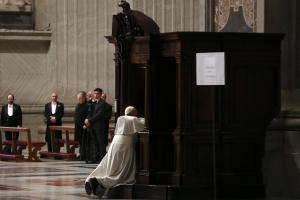
Pope Francis receives confession during the penitential …

Pope Francis receives confession during the penitential celebration in St. Peter's Basilica at t …

Fifty years later, the Church is facing a similar set of dilemmas and is beset by divisions over how to respond to them and close the gap between what it officially preaches and how many of its followers actually live their lives in the early 21st Century.

Deep divisions over how the Church should relate to homosexual, divorced and co-habiting believers were aired at an inconclusive, sometimes rancorous, synod of bishops in October-November 2014. They will be revisited when senior clerics re-assemble in Vatican City this October.

Francis, the first pope to hail from Latin America, is regarded by most of the world as having been a huge success in his two years at the helm of the Church.

His easy charm, decisive approach to issues such as paedophile priests and his pleas for a more merciful and worldly approach on questions like homosexuality and divorce have endeared him to a much broader public than his conservative, dour predecessor Benedict XVI could reach.

But he has not endeared himself to everyone within the Church.

Pope declares jubilee in powerful reform signal - Yahoo News

Pope Francis Gets The Problem With Money In Politics Exactly Right

image

image 

Francis succinctly summarized the corrupting influence that money can have in elections during an interview with a group of Argentine teenagers from a Buenos Aires slum, Crux reported.

Speaking about elections in his home country of Argentina, the pope said that candidates can become too beholden to donors who back their campaigns.

"Because many interests come into play in financing of an election campaign and then they ask you to pay back," he said in the interview. "So, the election campaign should be independent from anyone who may finance it."

The pope also said that a public finance system for elections would create more transparency.

"Perhaps public financing would allow for me, the citizen, to know that I'm financing each candidate with a given amount of money," he said.

Although the pope was speaking about Argentina, some quickly seized on his comments to make the case for reforming the influence of money in American politics. In the landmark 2010 case Citizens United v. FEC, the Supreme Court ruled 5-4 that independent political groups, such as corporations and unions, could spend unlimited sums of money in elections. The ruling has led to a flood of campaign spending from various groups, and President Barack Obama has said that the decision "has caused real harm to our democracy."

Pope Francis Gets The Problem With Money In Politics Exactly Right

Wednesday, March 4, 2015

Pope Francis cements financial reform in new laws, creates Vatican auditor general | National Catholic Reporter


Ending weeks of speculation that curial officials would stop his reform of the Vatican's scandal-plagued finances, Pope Francis has approved a set of new legislative norms that formalize his moves to bring financial accountability and transparency to the Catholic church's central bureaucracy.

The new laws concretize the pope's creation last year of a new central Vatican office with wide control over financial matters, giving that office authority to mandate financial standards for Vatican departments and power to monitor and review the implementation of such standards.

The pope has also created a new position within the Vatican bureaucracy for an auditor general, giving that as-yet unnamed person near-complete authority to investigate irregularities in accounting -- extending even to unannounced on-site investigations of Vatican offices.

Francis made the financial moves in a new series of norms, known together as a motu proprio, that were posted to the Vatican website Tuesday. The norms, which were signed Feb. 22 and went into effect Sunday -- concern three Vatican entities: the Council for the Economy, the Secretariat for the Economy, and the new office of the auditor general.

The pope created the council and the secretariat in February 2014, appointing German Cardinal Reinhard Marx to lead the former and Australian Cardinal George Pell to lead the latter.

Attention subscribers and donors! We’re rolling out an
online account management tool. Don’t miss out.
Add or confirm your email address today.

The council is an oversight body of 15 members that meets occasionally at the Vatican, while the secretariat was launched as an entirely new Vatican office to consolidate and control the many diverse curial offices that control church finances.

Before the issuing of Tuesday's norms, there had been speculation that Pell's power as the head of the secretariat might be curtailed to meet criticisms from some Vatican officials that he was being given too much authority.

Adding to the intrigue was the publication by the Italian magazine l'Espresso last week of accusations that Pell himself was misspending Vatican money, which the secretariat staunchly refuted in a press release.

Outlining the powers of the council, secretariat, and auditor general separately, the norms are particularly sweeping in describing the authority given to Pell and to the new auditor.

The norms specify that the Secretariat for the Economy is to have two sections: one designated to control and watch over Vatican finances and another to administration of the secretariat itself.

Under the authority of the first section, the norms specify Pell is to have the power to issue executive decrees to all Vatican departments concerning their guidelines and procedures "aimed at effective planning, budget forecasting and management of human, financial and material resources entrusted to the departments of the Roman Curia."

Marking substantial changes to a culture of opacity -- where Vatican offices have operated for years without a central budget or accounting system -- the first section of the secretariat is also to have power to analyze all Vatican operations to ensure all activities are "carried out efficiently" and are "in compliance with the approved budgets."

Likewise, the norms specify that the secretariat is to create one centralized budget for the entire Vatican and a consolidated balance sheet to show earnings and expenditures of each curial office. The norms do, however, make a distinction in the secretariat's power over the Vatican City State and the Holy See, the Vatican's diplomatic entity.

While the laws state clearly that the secretariat "controls the annual budget and the final budget of the State of Vatican City," they state that the office "prepares" the budget for the Holy See.

Obliquely referencing past news reports that Vatican offices may have inappropriately sold expensive properties they owned in Rome and other cities, the norms also give Pell the power to "approve every act of alienation, purchase or extraordinary administration put in place by the departments of the Roman Curia or institutions linked to the Holy See."

Pell is also empowered to ask the newly created auditor general to make specific reviews of any Vatican office. Creating the new auditing office in the norms, Francis writes that the office is to be composed of one auditor general and two assisting auditors.

The auditing office, he writes, is to have four key roles that are to be fulfilled "in full autonomy and independence and following the best internationally recognized practices in the field of public administration."

Those four roles:

  • Implementing an annual auditing program for Vatican entities;
  • Performing reviews on those entities "when he deems it necessary or if it is requested by the Council for the Economy";
  • Receiving reports of "anomalies in the activities of institutions and administrations" and investigating those; and
  • Proposing new "appropriate measures" to be followed in financial accounting.

The auditor's office is given power to perform specific reviews "whenever there is reasonable cause to suspect that" there are:

  • Initiatives and activities that "deviate substantially" from approved budgets;
  • "Anomalies in the use or ownership of financial resources or materials";
  • "Irregularities in the accounts or records";
  • "Significant irregularities in the awarding of agreements or contracts for outside services or in the carrying out of transactions or disposals"; and
  • Acts of "corruption, embezzlement or fraud."

Tuesday's norms specify that the Council for the Economy is to "receive and consider" reports from both the auditor's office and the economy secretariat. That body, Francis writes, is to "exercise its functions in the light of the Gospel and according to the social doctrine of the Church."

Francis also formalized the current structure of the council, mandating that eight of its 15 members must be either cardinals or bishops and the remaining seven must be laypeople. The terms for all members are set at five years, with a limit of two terms.

During meetings, members of the council "are required to disclose any conflict of interest resulting from other offices, private investments or relationships of cooperation in place with the Holy See, the State of the Vatican City or any other subject that may have a business relationship."

"The member who is in a situation of conflict of interest shall not participate in discussions in relation to which the conflict may have relevance," Francis writes.

While Pell is able to participate in the council meetings, he does not have a right to vote in their deliberations. Likewise able to attend with the same restriction is the Vatican's secretary of state, Cardinal Pietro Parolin.

The secretary of state is mentioned again in the norms in the section about the powers of the Secretariat for the Economy, where Francis writes that Pell and Parolin should "work in collaboration" but stipulates that Parolin "has sole competence for matters relating to relations with States and other subjects of public international law."

Pointing to just how expansive the powers of the Secretariat for the Economy are, the pope also writes that the secretariat is to help in processing Vatican salaries, creating hiring and firing practices for employees, proposing professional training courses, and managing personal data of Vatican staff.

[Joshua J. McElwee is NCR Vatican correspondent

Pope Francis cements financial reform in new laws, creates Vatican auditor general | National Catholic Reporter

Friday, February 27, 2015

Vatican denounces leaks of documents on finance reforms - Yahoo Finance


VATICAN CITY (AP) — The Vatican spokesman on Friday condemned as "unworthy and petty" the leaks of documents detailing power struggles inside the Holy See and the expenditures of Pope Francis' new finance czar.

In a cover story Friday, Italy's L'Espresso weekly detailed opposition to Cardinal George Pell's financial reform and revealed that his Secretariat for the Economy had racked up a half million euros (dollars) in expenditures in the last six months. Some of the expenses seemed legitimate, but one was a 2,508-euro ($2,800) bill from Rome's swanky Gamarelli tailor.

The Vatican spokesman, Rev. Federico Lombardi, condemned the leaks as illegal and called the attacks on Pell "unworthy and petty." He said Pell's office was moving ahead efficiently with reforms.

Pope Francis tasked Pell last year to put the Vatican's finances in order after years of mismanagement, waste and scandal. Francis gave him broad powers and the Australian has received widespread support from cardinals outside Rome.

But questions have swirled about the scope of his power and resistance has grown from within the entrenched Vatican bureaucracy, especially after Pell boasted that he had "discovered" hundreds of millions of euros "tucked away" in accounts off the Vatican balance sheet.

In fact, the money was well-known and much of it was purposefully set aside as reserves for funding shortfalls.

The leaks to L'Espresso were clearly aimed at discrediting Pell and harked back to the "Vati-leaks" affair that tarnished the final year of Pope Benedict XVI's papacy. In that scandal, Benedict's butler leaked reams of papal documents to an Italian journalist, aiming to discredit the Vatican's No. 2 official.

The documents also laid bare the dysfunctions and political intrigue that afflict the Vatican bureaucracy — problems that were central to Francis' election as pope with a mandate for reform

Vatican denounces leaks of documents on finance reforms - Yahoo Finance

Homeless Catholic Man Buried At Vatican Cemetery In Honor Of Years Of Faith


A homeless man who became a regular figure at the Vatican for his years of Catholic devotion was buried in a Vatican City cemetery after his remains were left in a morgue unidentified for nearly two months. Pope Francis personally authorized Willy Herteller to be buried in the Teutonic Cemetery, which was founded around the year 800 as a resting place for knights, fallen Swiss guards and royalty.

Herteller, thought to be around 80 years old, “attended 7 o’clock Mass every day for more than 25 years,” said the Rev. Bruno Silvestrinia, pastor of the Vatican’s Church of St. Anne, according to the National Catholic Reporter. He had become known by the Swiss Guard, church officials and other regulars around the Vatican. He would often hang out near St. Peter’s Square and discuss his faith with tourists and pilgrims who came to Vatican City, surviving on their charity and the help of locals.

Herteller died on Dec. 12, 2014, after collapsing on a cold night outside the Vatican grounds and ….

Click on the following to read more:  Homeless Catholic Man Buried At Vatican Cemetery In Honor Of Years Of Faith

Thursday, February 26, 2015

Two years on: forgotten pope sees out days in the shadows - Yahoo News


A year ago he was quoted as saying that his decision to step down had been the product of a mystical experience and that Francis's confident leadership had helped him understand why God had willed him to step aside.

He wrote to Italian newspaper La Stampa to dismiss a claim that he had been forced out against his will: which, were it true, would invalidate Francis's status as the leader of the Church.

There has also been much speculation that Benedict quit because he was on the verge of a nervous breakdown, unable to cope with the pressure of the top job in an institution beset by a series of problems ranging from paedophile clerics to financial scandals surrounding the Vatican bank.

The leaking of his personal correspondence by his butler Paolo Gabriele was said to have left Benedict deeply dismayed, the resulting court case having lifted the lid on a Vatican hierarchy beset by corruption, nepotism and fierce internal rivalries.

On all those questions however, the now Emeritus Pope has maintained a discreet silence, as he promised he would at the time of his departure.

Whether he genuinely approves of Francis in terms of style and/or substance remains unknown.

But what does seem clear is that the 87-year-old seems to be in better health now than he was when he made his shock announcement to cardinals that he no longer had the strength of mind or body to carry on.

His private secretary, Archbishop Georg Ganswein, recently revealed that Benedict regularly plays Mozart on the piano from memory.


He is a little unsteady on his legs at times but not alarmingly so for a man approaching his 88th birthday.

And intellectually, according to Ganswein, he is as sharp as ever, having recently produced a theological text on questions of truth for the benefit of Vatican scholars.

Francis has insisted there is no friction between the two popes.

"The last time there were two or three popes, they didn't talk among themselves and they fought over who was the true pope," he joked in July 2013.

And there was a flash of affection when the new pope said of the unusual situation of having two popes living so close to each other: "It is like having a grandfather – a wise grandfather – living at home."

But Vatican expert Andrea Tornielli says no one should be in any doubt as to who is the boss. "Benedict is very discreet. If he appears in public it is at Francis's request."

Two years on: forgotten pope sees out days in the shadows - Yahoo News

Monday, February 23, 2015

Pope gets away from Vatican to work on correcting 'defects' - Yahoo News


he and top aides will begin a spiritual renewal retreat Sunday. Until Friday morning, they will spend time listening to reflections, meditating and praying in Ariccia, a Rome suburb.

The pope said that amid "the noise, the confusion," one hears "only superficial voices." During the retreat "we can listen to the voice of Jesus and also correct so many defects we all have," he said.

Inviting prayers, Francis said the time away from the Vatican will also help participants "face the temptations that attack us every day."

He didn't list the "defects" he says needs fixing. But in the nearly two years since becoming pontiff, Francis has put prelates on guard against careerism, arrogance, hypocrisy, corruption and being too judgmental instead of merciful.

Francis said "spiritual conversion and growth starts from the heart. It's there that the match of daily choices between good and evil, worldliness and Gospel, indifference and sharing gets played."

The Catholic church encourages spiritual renewal in Lent, when faithful prepare for Easter, which this year falls on April 5.

The retreat means Francis won't hold his traditional weekly public audience on Wednesday.

Pope gets away from Vatican to work on correcting 'defects' - Yahoo News

Sunday, February 22, 2015

German Chancellor Merkel meets with Pope Francis | News | DW.DE | 21.02.2015


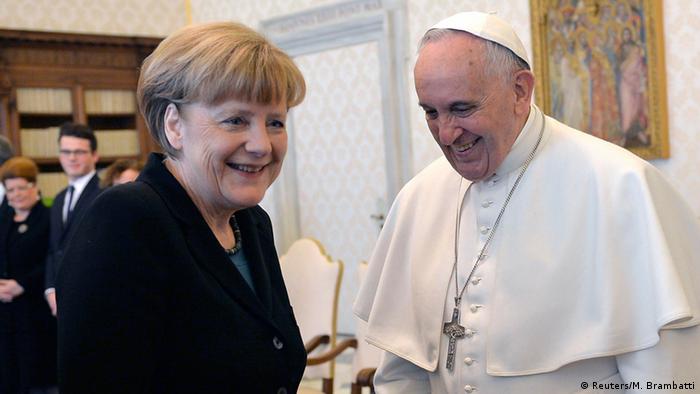
Pope Francis has received German Chancellor Angela Merkel for a private audience at the Vatican. The talks focused on the fight against poverty and international crises, including the conflict in eastern Ukraine.

Angela Merkel and Pope Francis

The German chancellor had a 40-minute private meeting with the head of the Catholic Church on Saturday, after which she told reporters, "I was very happy to meet with the pope."

Angela Merkel described the talks as "enriching" and wide-ranging, covering the alleviation of poverty, the role of women in developing countries, equality, and Germany's agenda for the upcoming Group of Seven (G7) summit in the southern German state of Bavaria in June.

Germany currently chairs the G7 group of major industrialized states, consisting of Germany, the United States, Canada, Japan, France, Italy and Britain. Russia had been a part of what was formerly known as the G8, before it was excluded over Moscow's annexation of Ukraine's Crimea region.

The conflict in eastern Ukraine was also discussed at the meeting with the pontiff, Merkel said, adding that "he gave me a lot of encouragement" to proceed "decidedly and determinedly" to find a solution. Fighting is continuing in the region, despite a ceasefire deal, brokered by Germany, France, Ukraine and Russia, that went into force last Sunday.

Pope Francis presented Merkel with a medallion depicting St. Martin giving his coat to the needy, saying it aimed to remind world leaders their job is "to protect their poor." Merkel responded: "We try to do our best." Merkel gave the pope a Johann Sebastian Bach CD and a donation to help children affected by conflicts in the Middle East.

Following her audience with the pope - the second since he was appointed - Merkel met Vatican Secretary of State Pietro Parolin and German ambassador to the Holy See, Annette Schavan. Schavan, a former German education minister, was considered one of Merkel's close confidantes before she resigned from her post amid a plagiarism scandal in 2013.

German Chancellor Merkel meets with Pope Francis | News | DW.DE | 21.02.2015

Wednesday, February 18, 2015

Pope Francis: Jesus Is Not Afraid of This Kind of Scandal


….Francis told hundreds of cardinals and bishops arrayed before him in St. Peter's Basilica at a Mass centered on the story of Jesus healing a leper rather than rejecting him.

"Even today it can happen that we stand at the crossroads of these two ways of thinking," the pope said as he outlined the current debate in the church between those seen as doctrinal legalists and those, like Francis, who want a more pastoral approach.

"Jesus responds immediately to the leper's plea, without waiting to study the situation and all its possible consequences," Francis declared. "For Jesus, what matters above all is reaching out to save those far off, healing the wounds of the sick, restoring everyone to God's family. And this is scandalous to some people!"

"Jesus is not afraid of this kind of scandal," the pontiff continued. "He does not think of the close-minded who are scandalized even by a work of healing, scandalized before any kind of openness, by any action outside of their mental and spiritual boxes, by any caress or sign of tenderness which does not fit into their usual thinking and their ritual purity."

Since his election almost two years ago, Francis has pushed the church to focus less on denouncing the sins of others — especially on issues of sexual morality — and to instead to reach out more to the poor and social outcasts.

He also wants the church, especially the leadership, to reform itself, and he has convened a series of high-level summits at the Vatican to discuss overhauling the Vatican bureaucracy and changing church practices to, for example, enable divorced and remarried Catholics to receive Communion.

But there was a sense at meetings in the Vatican over the past week that the momentum for change may be slowing — in part due to resistance from doctrinal conservatives and the Vatican's old guard — and could use a jump-start.

Francis seemed to provide such a jolt on Sunday in remarks that were "truly foundational," in the words of the Rev. Antonio Spadaro, an Italian Jesuit who is close to the pope.

The Rev. Thomas Rosica, a Canadian priest who works with the Vatican communications office,tweeted that "more than anything I've heard from (the pope) today's homily is his mission statement."

Throughout his 15-minute homily, Francis repeatedly slammed the "narrow and prejudiced mentality" of believers who cling to religious laws out of fear. They wind up rejecting the very people they should be ministering to, he said, which means anyone on the margins of society "who encounters discrimination."

"Total openness to serving others is our hallmark, it alone is our title of honor!" Francis said at the Mass to mark his appointment of 20 new cardinals on Saturday.

"We will not find the Lord unless we truly accept the marginalized!" he concluded. "Truly the Gospel of the marginalized is where our credibility is at stake, where it is found, and where it is revealed."

The new cardinals had joined Francis and more than 150 other members of the College of Cardinals for talks over the past week on restructuring the dysfunctional papal bureaucracy known as the Roman Curia.

But the background noise to those meetings, and in other, smaller meetings among the pope's top advisers, was the ongoing and increasingly pointed arguments between those who want to slow or halt Francis' drive for change and those who think the 78-year-old pontiff needs to act more decisively, and soon.

Francis himself seemed to acknowledge the opposition, citing New Testament passages in which St. Peter (considered by Catholic tradition to be the first pope – was rebuked by other early church leaders for entering the house of a pagan, and when St. Paul faced criticism for not requiring Christian converts to observe all aspects of Jewish law.

"Charity is creative in finding the right words to speak to all those considered incurable and hence untouchable," Francis said. "Contact is the true language of communication."

Francis said this mission applied to anyone in today's world who is pushed aside "for whatever reason."

But he also listed specific examples, saying the cardinals should see "the crucified Lord" in the hungry and the unemployed, those who are in prison and "even in those who have lost their faith, or declared themselves to be atheists, or turned away from the practice of the faith."

Read more:  Pope Francis: Jesus Is Not Afraid of This Kind of Scandal

Tuesday, February 17, 2015

Gay Catholics find a new tone under Pope Francis, and from their own bishops - The Washington Post


By David Gibson | Religion News Service February 16 at 5:21 PM

ROME — On its 15 previous pilgrimages, the Catholic gay rights group New Ways Ministry drew maybe two-dozen people to visit holy sites in places like Assisi and Rome.

This year, the number of pilgrims unexpectedly doubled to 50.

Chalk it up to the so-called Francis Effect, where the pope’s open-arms acceptance is giving new hope to gay and lesbian Catholics who have felt alienated from their church for decades.

What’s been even more surprising is that both New Ways and a similar Catholic LGBT organization in Britain are finding support from the Catholic hierarchy in their efforts to meet the pontiff when they both visit the Vatican on Ash Wednesday (Feb. 18), the start of Lent, the period of penance and fasting preceding Easter.

For example, Archbishop Georg Ganswein, head of the papal household and the top aide to Pope Emeritus Benedict XVI, responded to New Ways’ request for a papal meet-and-greet by reserving tickets for the group at Francis’ weekly public audience in St. Peter’s Square. It’s not a private meeting — which is tough for anyone to get — but it’s not nothing.

The pope’s ambassador to Washington forwarded a similar request to Rome. Even San Francisco Archbishop Salvatore Cordileone — point man for the U.S. Conference of Catholic Bishops’ battle against gay marriage — had written a letter to the Vatican on their behalf.

Last December, Cordileone had a constructive meeting with Frank DeBernardo, executive director of New Ways, and Sister Jeannine Gramick, a co-founder of New Ways and a longtime advocate for LGBT inclusion in the church. But they were still surprised by the archbishop’s willingness to write a letter for them.

Moreover, British Cardinal Vincent Nichols of Westminster sent a warm blessing to a group of LGBT Catholics from London who are joining up with New Ways in Rome. “Be assured of my prayers for each and every one of you,” Nichols wrote. “Have a wonderful pilgrimage. God bless you all.”

Read the entire article by clicking on the following:  Gay Catholics find a new tone under Pope Francis, and from their own bishops - The Washington Post

Monday, February 16, 2015

Pope's man in Ireland oversees a quiet revolution


A quiet revolution has been taking place in the leadership of the Catholic Church in Ireland since Archbishop Charles Brown became papal nuncio three years ago. He has overseen the appointment of 10 new bishops to Ireland’s 26 dioceses, with potentially five more to come this year.

Included in the appointments made are two of the church’s four archbishops, one of them the new Catholic primate of All Ireland, Archbishop Eamon Martin, who at 53 is also one the youngest bishops on the island. The youngest is the new Bishop of Kildare & Leighlin Denis Nulty (51).

No papal nuncio before has overseen the appointment of so many bishops in such a short time. This has been down to retirements, resignations, and ill-health. But it is likely to have a major influence on the Irish church in the years to come.

February has seen the appointment of a new bishop and the installation of another one. Fr Alphonsus Cullinan (55), a priest of Limerick diocese, was appointed to succeed Bishop Emeritus of Waterford & Lismore William Lee, who retired on grounds of ill-health.

The new Archbishop of Cashel & Emly, Kieran O’Reilly(62), was installed in the post after moving from Killaloe diocese where he was bishop since August 2010.

 
Neither was a priest of the diocese to which he has been appointed, representing a departure from the practice where a bishop generally came from among priests in the diocese.

There appears to be less emphasis nowadays on academic qualifications, as opposed to pastoral experience, in the selection of candidates.

Within two years of his arrival in January 2012, Archbishop Brown had appointed six new bishops, some to particularly sensitive postings following publication of the Murphy report in 2009 into sexual abuse in the Dublin archdiocese and the Cloyne report in 2011 into sexual abuse in that diocese.

In January 2013 he ordained Fr William Crean (63), parish priest of Cahirciveen, Co Kerry, as Bishop of Cloyne, succeeding Bishop John Magee, who resigned followed publication of the Cloyne report.

Msgr Brendan Leahy (54), a priest of the Dublin archdiocese, was ordained Bishop of Limerick in April 2013, succeeding Bishop Donal Murray, who resigned following the Murphy report.

In April 2013 Msgr Eamon Martin was ordained Coadjutor Archbishop of Armagh. He succeeded Cardinal Sean Brady, who retired on age grounds, as Primate of All Ireland in September 2014.

In July 2013 Fr Raymond Browne (57), a priest of Elphin diocese, was ordained Bishop of Kerry, succeeding Bishop William Murphy, who retired on age grounds.

In August 2013 Bishop Denis Nulty, a parish priest in Dundalk, was ordained Bishop of Kildare & Leighlin, succeeding Bishop Jim Moriarty, who resigned following the Murphy report.

In October 2013 a priest of Kilmore diocese, Fr Francis Duffy (56), was ordained Bishop of Ardagh & Clonmacnois, succeeding Bishop Colm O’Reilly, who retired on age grounds.

Since 2013 four more episcopal appointments included Down & Connor Auxiliary Bishop Donal McKeown (65) as Bishop of Derry in April 2014; Dublin parish priest Fr Kevin Doran (61) as Bishop of Elphin in July 2014; Bishop O’Reilly as Archbishop of Cashel & Emly; and Fr Cullinan as Bishop of Waterford & Lismore.

Five other appointments may potentially take place in 2015 in Killaloe, Clonfert, Raphoe, Meath, and Cork & Ross dioceses.The appointment to Killaloe will fill the vacancy created by the “translation” of Bishop O’Reilly to Cashel & Emly.

Before the end of June four bishops will have reached the age of 75 when every bishop must offer a letter of resignation to Rome. It is at the pope’s discretion when it is accepted.

The Bishop of Clonfert, John Kirby, was 75 in October 2013. Bishop of Cork & Ross John Buckley was 75 in November 2014, while the Bishop of Raphoe, Philip Boyce, was 75 on January 25th, 2015. Ireland’s longest serving bishop, Bishop of Meath Michael Smith, was ordained Coadjutor bishop of the diocese in 1988 and is 75 in June 2015.

Auxiliary bishops

One of the three remaining auxiliary bishops in Ireland, Bishop Anthony Farguhar of Down & Connor diocese, is 75 in September 2015. Should his resignation be accepted it will mean there will be just two auxiliary bishops remaining in Ireland.

Bishop Ray Field was 70 last May, and Bishop Eamonn Walsh was 70 last September.

No new auxiliary bishop has been appointed in Ireland since April 2001, when Bishop Donal McKeown became auxiliary bishop in Down & Connor.

Assuming all potential vacancies arising this year are filled, it is the first time in Ireland for 15 bishops to be appointed so quickly after a papal nuncio’s arrival.

The influence of Archbishop Brown on these appointments has been central. Considering his background at the Congregation for the Doctrine of the Faith in Rome, where he worked for 17 years before coming to Ireland, and that some new bishops are of a traditional hue, the emphasis on pastoral experience in selecting bishops has come as something of a welcome surprise. Clearly valuable lessons have been learned.

Archbishop Charles Brown: profile of a New Yorker who became papal nuncio to Ireland

Archbishop Charles Brown (55) is a native New Yorker, born in Manhattan’s predominantly Jewish East Village area. The family moved upstate when he was five. He is the eldest of six, born to a lawyer father with German lineage and an Irish American mother Patricia Murphy.

He has said: “Of my eight great-grandparents, five were Irish and the others were German... My Irish ancestors came to America during and after the Famine. They left because they were poor.”

Ordained for New York in 1989, he served in a Bronx parish for two years before going to Rome for studies. In 1994 he joined the Congregation for the Doctrine of the Faith (CDF) in Rome which needed an English speaker.

Working alongside the future Pope Benedict XVI there for 10 years, he remained at the CDF until November 2011, when it was announced he had been appointed papal nuncio to Ireland. This was at the direct request of Pope Benedict and a surprise as Archbishop Brown had not been a member of the Vatican’s diplomatic corps.

Since his arrival in Ireland he has not been without critics. At the World Day of Peace Mass on New Year’s Day 2013 in the Church of St Thérèse in Dublin, he spoke forcefully on the “need to work vigorously and courageously to protect and nurture human life from conception to natural death”.

This was in advance of the debate on the Protection of Life During Pregnancy Bill and a week before the Oireachtas health committee began its hearings on the Bill. His congregation included President Michael D Higgins, the Taoiseach’s aide-de-camp Cmmdt Michael Treacy, representatives of the political parties and members of the judiciary and the diplomatic corps. While no one was surprised to hear a Catholic bishop speak in such terms on the issue, it was felt by many present that the occasion was inappropriate.

In September 2013, co-founder of the Association of Catholic Priests Fr Brendan Hoban queried whether the new nuncio was “the right man to appoint, effectively on his own, a whole phalanx of new bishops”.

Archbishop Brown, he said, had “spent very little time in parish work and he has no formal training as a papal nuncio, in that he was catapulted out of the Congregation for the Doctrine of the Faith into the diplomatic service by Pope Benedict as Rome’s answer to the dysfunctional Irish Catholic Church”.

Archbishop Brown has been very active meeting and greeting. He has made a positive impression overall which, it is believed, helped towards Ireland’s Embassy to the Holy See being reopened last year.

Pope's man in Ireland oversees a quiet revolution