Showing posts with label Vatican Council II. Show all posts

Friday, March 13, 2015

Pope declares jubilee in powerful reform signal - Yahoo News


Vatican City (AFP) - Pope Francis on Friday marked the second anniversary of his election by declaring a jubilee year that will be interpreted as a powerful signal of his commitment to reforming the Church.

The extraordinary holy year, dedicated to the theme of mercy, has been called to celebrate the 50th anniversary of a groundbreaking Vatican council that transformed how the Church related to the modern world, most notably ending the obligation for religious services to be conducted in Latin.

The jubilee year will begin on December 8 and run until November 20, 2016. December 8 is one of the holiest dates in the Catholic calender as the Feast of the Immaculate Conception and is also the date on which the Vatican II council closed in 1965.

Speaking in St Peter's cathedral, the 78-year-old pontiff described the year's start date as being "of great significance, for it impels the Church to continue the work begun at Vatican II."

Vatican II is considered to be one of the defining moments in the history of the Catholic church -- the point at which the clerical hierarchy accepted that some centuries-old ways of thinking and acting had to be jettisoned if the institution was to remain relevant as the sixties began to swing.

- A divided Church -

View gallery

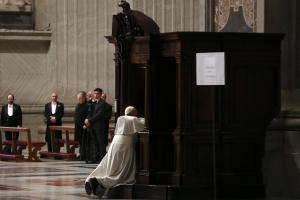
Pope Francis receives confession during the penitential …

Pope Francis receives confession during the penitential celebration in St. Peter's Basilica at t …

Fifty years later, the Church is facing a similar set of dilemmas and is beset by divisions over how to respond to them and close the gap between what it officially preaches and how many of its followers actually live their lives in the early 21st Century.

Deep divisions over how the Church should relate to homosexual, divorced and co-habiting believers were aired at an inconclusive, sometimes rancorous, synod of bishops in October-November 2014. They will be revisited when senior clerics re-assemble in Vatican City this October.

Francis, the first pope to hail from Latin America, is regarded by most of the world as having been a huge success in his two years at the helm of the Church.

His easy charm, decisive approach to issues such as paedophile priests and his pleas for a more merciful and worldly approach on questions like homosexuality and divorce have endeared him to a much broader public than his conservative, dour predecessor Benedict XVI could reach.

But he has not endeared himself to everyone within the Church.

Pope declares jubilee in powerful reform signal - Yahoo News

Thursday, February 19, 2015

Priests ask bishops: Make Sacrament of Penance more accessible


Ash Wednesday is the beginning of Lent, a traditional time of prayer, fasting and almsgiving for many Christians. Lent is also a time when the Catholic Church emphasizes the need for repentance, conversion and penance. A group of Catholic priests in the United States has chosen Lent as the time to seek expansion of the opportunities for confession and sacramental reconciliation.

Catholics of a certain age “went to Confession” on a regular basis, privately telling a priest the list of mortal and venial sins he or she had committed since the last confession. After making an Act of Contrition and a firm commitment to sin no more, the penitent received a penance – usually a set of prayers to be said – and finally, individual absolution.

Most Catholics today however have little or no such experience – and that is a reality that concerns the members of the Association of U.S. Catholic Priests. Their concern first surfaced at the 2013 Assembly in Seattle, and now the AUSCP, with over a thousand members, hopes to convince the bishops of the United States to do what they can to expand possibilities for Catholics to celebrate the Sacrament of Reconciliation.

What the priests are asking is defined in carefully chosen canonical terms, and requested within a well-reasoned theological framework. No special terminology is needed to describe the reality: 45 percent of U.S. Catholics never celebrate the Sacrament of Reconciliation; another 30 percent “go to Confession” less than once a year.
— Center for Applied Research in the Apostolate, Georgetown University, 2008.

The priests have asked their bishops to seek full Catholic Church approval for the full restoration and implementation of the Rite of Penance that was approved following the Second Vatican Council.

• Rite 1 includes private confession and absolution.

• Rite 2 includes a common liturgical service followed by individual confession and absolution – a practice that is often truncated as large numbers of penitents meet a small number of priests with limited time available.

• Rite 3 envisions a communal celebration with communal absolution, with a requirement that a penitent follow up at a later time with a private confession if grave sins are involved.

The priests, who as a group have literally hundreds of thousands of hours of experience in the confessional, believe that Rite 1 private confession should be available every week. They believe that Rite 2 does not offer adequate pastoral care for penitents, but that Rite 3, with a communal liturgical service and communal absolution, would best allow the parish community to “commit anew to conversion, experience the merciful love of God, and work with the Lord in his ministry of reconciliation.”
— AUSCP Background Document

Technically, the AUSCP is asking the United States Conference of Catholic Bishops to request an indult from the Holy See to allow celebration of the Rite 3 of Penance in parishes in the United States.

Celebrating the sacrament in this fashion, they believe, may actually bring more Catholics back to personal, private confessions – the practice that has been all but abandoned by 75 percent of Catholics in the United States. Rite 3 would “move hearts in the future toward the value of periodic personal confession with its availability of pastoral counseling and spiritual direction.”

A letter from the AUSCP, dated February 10, 2015, was sent to Archbishop Joseph E. Kurtz of Louisville, president of the USCCB, to members of the conference’s Committee for Divine Worship, and to all bishop members of the conference.

The full text of the letter to Archbishop Kurtz, and to the U.S. bishops follows this release.

The AUSCP 14-page background document regarding full restoration and implementation of the Rite of Penance will be posted Wednesday, February 18, at http://www.uscatholicpriests.org/our-work/

Father Bernard “Bob” Bonnot, a priest of the Diocese of Youngstown, chairs the leadership team of the AUSCP and is available to speak for the association.

Priests ask bishops: Make Sacrament of Penance more accessible

Saturday, January 3, 2015

Editorial: Person of the year for 2014 | National Catholic Reporter


NCR Editorial Staff  |  Dec. 30, 2014

The Francis Chronicles

Share on facebook Share on twitter More Sharing Services 181

PrintemailPDF

Editorial

A year ago, Pope Francis' photo adorned the covers of Rolling Stone, The New Yorker, TIME magazine and The Advocate. The latter two named the pope their person of the year. Francis' personal humility and simplicity, his common-sense rhetoric seasoned with homespun charm had captured the imagination of Catholics, non-Catholics and even nonbelievers. Acutely aware of the power of simple language and of images, Francis set about molding a pontificate for the age of Facebook and Twitter. Though he has little computer knowledge himself, Francis harnessed these tools for a new kind of evangelization.

Many among our readers, editors, staff and contributors embraced the message he advocated. They heralded not just a change in tone and style, but a change in substance and direction. Just as many among us, however, were not convinced. The refrain was, "Yes, but what has he done? To what real change can we point?" And so NCR resisted naming Francis our person of the year for 2013.

A year later, the resistance is weakening. We can name many points of disagreement with Francis: He is consistently tone-deaf in the way he speaks about women. We do not believe he clearly understands the powerful contribution women are already making to church life, and we believe he is mistaken not to appoint more women to leadership positions in church administration. His remarks to the November symposium at the Vatican, "An International Interreligious Colloquium on the Complementarity of Man and Woman," suggest he and the church hierarchy need an updated theology and science on human sexuality. Despite these objections, we also find a growing list of accomplishments.

One clear message from the conclave that elected Francis was that the new pope must reform the Roman Curia — not only to bring it up to date, but to restore its mission of service to the church at large. We have said that the reform of that institution needs changes in at least three key areas: a change in culture; personnel to support the reform; and new structures, policies and procedures to make it work.

Francis has made clear movement in all three of these areas. He has worked quickly and resolutely to build on reforms of the Vatican's financial system begun under Pope Benedict XVI. The Vatican bank will soon be held to the same international standards of transparency and accountability that other international institutions must follow. That is a great step forward and should go a long way in erasing the scandals that have periodically wracked that institution. Moreover, one of his appointees, Australian Cardinal George Pell, has in place a plan to modernize the administration of Vatican offices outside the bank as well.

envelope-gray-background.jpgLike what you're reading? Sign up for NCR email alerts.

The "examination of conscience" Francis administered during his annual Christmas greetings to the Curia shows that he is determined to change the culture of the Vatican. Some news accounts report that the cardinals and curial officials "sat stone-faced" during Francis' recitation of the diseases afflicting the Curia. The cultural change will eventually affect even the local chancery. Francis has told his nuncios, his ambassadors in countries around the world who are instrumental in selecting bishops for the local churches, to find "pastors who are close to their people … who are meek, patient and merciful" and to avoid "those who are ambitious, who seek the episcopacy." As he makes more appointments, the culture will change even among the leaders appointed by his predecessors.

We have taken Francis to task for not understanding the seriousness of the sex abuse crisis in the church. In the last year, Francis has made tremendous strides in this area by — most important — meeting with victims of clergy sexual assault and by appointing a high-level commission of professionals, half of whom are lay and women, to advise him directly. The commission has yet to act, but its formation indicates the pope is grappling with the issue.

Francis has also acted on his own words to take the church out of the sanctuary and into the streets. The first two teaching documents of his pontificate, last year's apostolic exhortation, Evangelii Gaudium ("The Joy of the Gospel"), and the encyclical on the environment anticipated this year have established the priorities of his papacy, speaking for the poor of this world where they are most vulnerable: squeezed by the global economy and threatened by environmental degradation. His teachings aren't entirely new, but follow the progression of these issues through all recent papacies, reaffirming that in Catholic social teaching people come before profit and property.

"Out in the streets," Francis has also demonstrated a certain deftness as a global diplomat. In the spring, he brought together in the Vatican Gardens Israeli President Shimon Peres and Palestinian President Mahmoud Abbas for an "invocation for peace" in the Holy Land. We are just learning that he played an instrumental role in thawing relations between Cuba and the United States. Peres has said that neither the United Nations nor its peacekeepers "have the force or the effectiveness of any one of the pope's homilies."

Perhaps Francis' greatest contribution as pope will be his embrace and advocacy for the Synod of Bishops as central to the governance and mission of the church. The two synods that Francis has called to discuss family life may result in changes in pastoral practices that will welcome Catholics back into full participation in the church, but the process the synods begin may well be their most important outcome. Francis is making of the synod what Pope Paul VI envisioned it to be in 1965: a body that would provide "for a continuance after the [Second Vatican] Council of the great abundance of benefits that … result of our close collaboration with the bishops."

By giving the synod such importance and by appointing his Council of Cardinals and convening them regularly, Francis is reshaping how a pope governs. He is one among many bishops, and they guide the church together. His preference for the title of bishop of Rome above all other titles clearly shows his intent. His reaching out to Ecumenical Patriarch Bartholomew underscores his desire for a church in full communion while also celebrating its diversity.

For all these reasons, we name Pope Francis NCR's person of the year for 2014.

Editorial: Person of the year for 2014 | National Catholic Reporter

Saturday, December 20, 2014

Pope Francis, Peacemaker in Cuba and Beyond - Bloomberg View


Pope Francis, Peacemaker

Dec 19, 2014 12:58 PM EST

By Francis Barry

When Pope John Paul II arrived at the airport in Havana in 1998 for a first-ever papal visit, he said: “May Cuba, with all its magnificent potential, open itself up to the world, and may the world open itself up to Cuba.”

Sixteen years later, a new pope -- himself no stranger to repressive dictatorship, having lived through Argentina’s “Dirty War” -- has helped breathe new life into those aspirations, by prodding the U.S. and Cuba into normalizing diplomatic relations.

The agreement between the two old antagonists effectively ends one of the last battles of the Cold War. It also highlights what could prove to be the most historically consequential aspect of Francis’ papacy: His commitment to the work of healing old wounds -- within his flock, with other churches and governments, and among bitter enemies. It may be the most ambitious peacemaking agenda any pope has ever undertaken.

Francis's active role in brokering the U.S.-Cuba detente wasn’t his only foray into peacemaking this year. When he visited South Korea in August, the Vatican convinced Chinese officials to allow the papal plane to fly over Chinese airspace, a first. While over China, the pope sent a goodwill message to President Xi Jinping and the Chinese people. The ultimate goal: Restoring Vatican ties to China, where Catholics have long been forced to worship underground or in churches run by the government.

In April, after a visit to the Middle East, Francis invited the Israeli and Palestinian presidents to the Vatican for a prayer session. Both accepted, and while no breakthrough resulted (and none was expected), the gesture reflected Francis’ willingness to become personally involved in peacemaking efforts. It was the first time the Vatican had ever hosted such a gathering with Mideast leaders.

The chief purpose of Francis’ Middle East trip was a meeting with the Patriarch of the Eastern Orthodox Church marking the 50th anniversary of a meeting that ended hostilities between the two churches, which split in 1054. Relations have steadily improved in recent decades, and Francis has said he wants to restore the churches into communion with each other, a message he repeated last month while attending an Orthodox service with Patriarch Bartholomew I in Istanbul. If he succeeds, it would be a monumental achievement for Christian unity.

Other popes have cautiously waded into these conflicts. Francis has been diving in. And that is especially true of his approach to healing the divisions within the Catholic Church itself.

In October, when Francis convened a major conference on family life, he thrust into the center of it questions about how the church can build stronger bonds with those who have felt abandoned, including gays and lesbians and remarried couples. He warned the bishops against “hostile rigidity” in their thinking and all but invited them to challenge the church’s status quo, evoking the same spirit that inspired so many changes at the Second Vatican Council.

Some were unhappy about the new openness, but the talks achieved what Francis wanted: Forcing the cardinals to approach issues from a pastoral perspective, centered on the church’s obligation to embrace those most in need of healing. “The church is called to waste no time in seeking to bind up open wounds," Francis said afterward, "and to rekindle hope in so many people who have lost hope."

Francis’ efforts to bind up old wounds is taking many forms. Not all will succeed, and there is always the possibility that new wounds may open as a result; critics have been quick to suggest a possible schism between the church’s liberal and conservative wings. But we are learning that his papacy is best understood by reading the prayer of the saint whose name he took, which begins: “Lord, make me an instrument of your peace.”

That plea seems to be getting heard.

To contact the author on this story:
Francis Barry at fbarry5@bloomberg.net

Pope Francis, Peacemaker in Cuba and Beyond - Bloomberg View

Saturday, July 20, 2013

Elderly Jesuit explains why he resigned from priesthood. Association of Catholic Priests


Fr Bert Thelen’s Letter of Resignation, June 2013

TO : Family, Relatives, and Friends, Colleagues and Partners in Ministry, CLC Members, Ignatian Associates, Project Mankind, Parishioners of St. John’s, St Benedict the Moor, Sacred Heart, Jesuit Classmates and Companions
FROM: Bert Thelen, S.J., June, 2013

Dearly Beloved,

May the Grace of Jesus Christ, the Love of God, and the Peace of the Holy Spirit be with you! I am writing to tell you about what may be the most important decision of my life since entering the Jesuits. With God’s help, at the behest of my religious superiors and the patient support and wise encouragement of my CLC group and closest friends, I have decided to leave ordained Jesuit ministry and return to the lay state, the priesthood of the faithful bestowed on me by my Baptism nearly 80 years ago. I do this with confidence and humility, clarity and wonder, gratitude and hope, joy and sorrow. No bitterness, no recrimination, no guilt, no regrets.

It has been a wonderful journey, a surprising adventure, an exploration into the God Who dwells mysteriously in all of our hearts. I will always be deeply grateful to the Society of Jesus for the formation, education, companionship, and ministry it has provided, and to my family for their constant support. I can never thank God enough for the loving and loyal presence in my life of each and every one of you.

Why am I doing this? How did I reach this decision? I will try to tell you now. That is the purpose of this letter. For about 15 years now, as many of you have noticed, I have had a “Lover’s Quarrel” with the Catholic Church. I am a cradle Catholic and grew up as Catholic as anyone can, with Priests and even Bishops in our household, and 17 years of Catholic education at St. Monica’s Grade School, Milwaukee Messmer High School, and Marquette University. I took First Vows at Oshkosh in the Society of Jesus at age 25 and was ordained at Gesu Church to the priesthood ten years later in 1968. I have served the Church as a Jesuit priest in Milwaukee, Omaha, and Pine Ridge for 45 years, including 18 years on the Province Staff culminating in my being the Wisconsin Provincial for six years and attending the 34th General Congregation in Rome.

My last 14 years at Creighton and St. John’s have been the best years of my life. I have truly enjoyed and flourished serving as pastor of St. John’s. I cannot even put into words how graced and loved and supported I have been by the parishioners, parish staff, campus ministry, Ignatian Associates, and CLC members! It is you who have freed, inspired, and encouraged me to the New Life to which I am now saying a strong and joyful “Yes.” You have done this by challenging me to be my best self as a disciple of Jesus, to proclaim boldly His Gospel of Love, and to widen the horizons of my heart to embrace the One New World we are called to serve in partnership with each other and our Triune God. It is the Risen Christ Who beckons me now toward a more universal connection with the Cosmos, the infinitely large eco-system we are all part of, the abundance and vastness of what Jesus called “the Reign of God.”

Why does this “YES” to embrace the call of our cosmic inter-connectedness mean saying “NO” to ordained ministry? My answer is simple but true. All mystical traditions, as well as modern science, teach us that we humans cannot be fully ourselves without being in communion with all that exists. Lasting justice for Earth and all her inhabitants is only possible within this sacred communion of being. We need conversion – conversion from the prevailing consciousness that views reality in terms of separateness, dualism, and even hierarchy, to a new awareness of ourselves as inter-dependent partners , sharing in one Earth-Human community. In plainer words, we need to end the world view that structures reality into higher and lower, superior and inferior, dominant and subordinate, which puts God over Humanity, humans over the rest of the world, men over women, the ordained over the laity. As Jesus commanded so succinctly, “Don’t Lord it over anyone … serve one another in love.” As an institution, the Church is not even close to that idea; its leadership works through domination, control, and punishment. So, following my call to serve this One World requires me to stop benefiting from the privilege, security, and prestige ordination has given me. I am doing this primarily out of the necessity and consequence of my new call, but, secondarily, as a protest against the social injustices and sinful exclusions perpetrated by a patriarchal church that refuses to consider ordination for women and marriage for same- sex couples.

I have become convinced that the Catholic Church will never give up its clerical privilege until and unless we priests (and bishops) willingly step down from our pedestals. Doing this would also put me in solidarity with my friend, Roy Bourgeois, my fellow Jesuit, Fr. Bill Brennan, the late Bernard Cooke, and many other men who have been “de-frocked” by the reigning hierarchy. It will also support the religious and lay women, former Catholics, and gay and lesbian couples marginalized by our church. I want to stand with and for them. I am, if you will, choosing to de-frock myself in order to serve God more faithfully, truly, and universally.

But why leave the Jesuits? Make no mistake about it: the Society of Jesus shares in and benefits from this patriarchal and clerical way of proceeding. We still regard ourselves as the shepherds and those to whom and with whom we minister as sheep. I discovered this painfully when the Society of Jesus decided against having Associate members. We are not prepared for co-membership or even, it seems at times, for collaboration, though we pay lip service to it. “Father knows best” remains the hallmark of our way of proceeding. I can no longer, in conscience, do that. But I still honor and love my fellow Jesuits who work from that model of power over. It is still where we all are as a company, a Society, a community of vowed religious in the Roman Catholic church. Leaving behind that companionship is not easy for me, but it is the right thing for me to do at this time in my life. When I went through a formal discernment process with my CLC group, one member whose brilliance and integrity I have always admired and whose love and loyalty to the Jesuits is beyond question, said of my decision, “You cannot NOT do this!” He had recognized God’s call in me.

A few other considerations may help clarify my path. The Church is in transition – actually in exile. In the Biblical tradition, the Egyptian, Assyrian and Babylonian captivities led to great religious reforms and the creation of renewed covenants. Think of Moses, Jeremiah, and Isaiah. I think a similar reform is happening in our Catholic faith (as well as other traditions). We have come through far-reaching, earth-shaking evolutionary changes, and a new (Universal) Church as well as a new (One) World is emerging. My decision is a baby step in that Great Emergence, a step God is asking me to take.

Consider this. Being a Lay Catholic has sometimes been caricatured as “Pray, pay, and obey.” Of course, that is a caricature, an exaggeration, a jibe. But it does point to a real problem. Recently, the hierarchical church mandated the so-called revision of the Roman Missal without consulting the People of God. It was both a foolish and a self-serving effort to increase the authority of Ordained men, damaging and even in some ways taking away the “Pray” part of “Pray, pay, and obey.” No wonder more and more Catholics are worshipping elsewhere, and some enlightened priests feel compromised in their roles. I, for one, feel that this so-called renewal , though licit, is not valid. It is not pleasing to God, and I feel compromised in trying to do it.

Now, consider this. All of this liturgical, ecclesial, and religious change is located in and strongly influenced by what both science and spirituality have revealed as happening to our world, our planet, our universe. The very earth we are rooted and grounded in, as well as the air we breathe and the water we drink, are being damaged and destroyed even beyond (some say) our capacity to survive. And, as Fr. John Surette, S.J., has so wisely observed, “Injustice for the human and destruction of Earth’s ecosystem are not two separate injustices. They are one.” Biocide is even more devastating than genocide, because it also kills future inhabitants of our precious Earth.

It is time. It is time to abandon our refusal to see that our very environment is central to the survival and well being of ALL earthlings. It is time for the Church to turn her attention from saving face to saving the earth, from saving souls to saving the planet. It is time to focus on the sacred bond that exists between us and the earth. It is time to join the Cosmic Christ in the Great Work of mending, repairing, nurturing, and protecting our evolving creation. It is time for a new vision of a universal Church whose all-inclusive justice and unconditional love, an expression of Christ consciousness and the work of the Holy Spirit, empowers ALL and can lead to a future that preserves the true right to life of all of God’s creatures. This includes future generations who will bless us for allowing them to live, evolve, and flourish. Can’t you hear them crying out, “I want to live, I want to grow, I want to be, I want to know?”

In light of all this, how can I not respond to the call both Isaiah and Jesus heard, the call of our Baptism? “The Spirit of the Lord is upon me, because the Lord has anointed me and sent me to bring Good News to the oppressed.” All creation will be freed, and all people will know the freedom and glory of the Children of God. Yes, Lord, I will go. Please send me.

And that is why I am leaving Jesuit priesthood. Since first vows I have always thought and hoped and prayed that I would live and die in this least Society of Jesus. But now, something unexpected! A real surprise! I HAVE lived and died in the Society of Jesus, but, now, nearly 80, I have been raised to new life. I am born again – into a much larger world, a much newer creation. I have greatly benefited from the spiritual freedom given in and by the Society of Jesus. I feel no longer chained, limited, bound, by the shackles of a judicial, institutional, clerical, hierarchical system. As St. Paul once reminded the early Christians, “It is for freedom that you have been set free.” And as St. Peter, the first Pope, learned when he said to Jesus, “You know that I love you,” love is all about surrender and servanthood.

Thank you for your attention to this self presentation. I am grateful that you have followed me in the journey described here, and I am sorry for whatever sadness, disappointment, or hurt this may have caused you. But what I have written here is my truth, and I can’t not do it! If you want to discuss this with me, ask questions, or give me feedback, I welcome your response, either by letter, e-mail or phone.
( 402-305-2665 ). Please pray for me, as I do for all of you, the beloved of my heart and soul.

Yours in the Risen Christ, Bert Thelen
The above is taken from:  Elderly Jesuit explains why he resigned from priesthood. Association of Catholic Priests

Saturday, April 20, 2013

Vatican: CDF holds talks with LCWR


Vatican: CDF holds talks with LCWR

2013-04-15 Vatican Radio
(Vatican Radio) Below we publish a communique issued Monday by the Congregation for the Doctrine of the Faith concerning a meeting with the Presidency of the Leadership Conference of the Women Religious in the USA.

Today the Superiors of the Congregation for the Doctrine of the Faith met with thePresidency of the Leadership Conference of Women Religious (LCWR) in the United States of
America. Most Rev. J. Peter Sartain, Archbishop of Seattle and the Holy See’s Delegate for theDoctrinal Assessment of the LCWR, also participated in the meeting.
As this was his first opportunity to meet with the Presidency of the LCWR, the Prefect of
the Congregation, Most Rev. Gerhard Ludwig Müller, expressed his gratitude for the greatcontribution of women Religious to the Church in the United States as seen particularly in the
many schools, hospitals, and institutions of support for the poor which have been founded andstaffed by Religious over the years.
The Prefect then highlighted the teaching of the Second Vatican Council regarding the
important mission of Religious to promote a vision of ecclesial communion founded on faith inJesus Christ and the teachings of the Church as faithfully taught through the ages under the
guidance of the Magisterium (Cf. Lumen gentium, nn. 43-47). He also emphasized that a
Conference of Major Superiors, such as the LCWR, exists in order to promote common effortsamong its member Institutes as well as cooperation with the local Conference of Bishops and
with individual Bishops. For this reason, such Conferences are constituted by and remain underthe direction of the Holy See (Cf. Code of Canon Law, cann. 708-709).
Finally, Archbishop Müller informed the Presidency that he had recently discussed the
Doctrinal Assessment with Pope Francis, who reaffirmed the findings of the Assessment and theprogram of reform for this Conference of Major Superiors.
It is the sincere desire of the Holy See that this meeting may help to promote the integralwitness of women Religious, based on a firm foundation of faith and Christian love, so as to
preserve and strengthen it for the enrichment of the Church and society for generations to come.

The above is take from:  Vatican: CDF holds talks with LCWR

Wednesday, January 23, 2013

Association of Catholic Priests « Bondings 2.0


An Irish Times news story of the press conference reported the scope of the Vatican’s Congregation for the Doctrine of the Faith (CDF) investiagation of the priest:

“Fr. Flannery told a press conference in Dublin yesterday he had been threatened with excommunication by the CDF for refusing to recant his more liberal views on church teachings concerning women priests, contraception and homosexuality.”

According to theBBC.com, at the press conference, Fr. Flannery stated that signing the loyalty pledge that the Vatican has asked for would violate his conscience:

” ‘It would mean that I was saying that I accept the teaching on contraception, which I have been on record for a long time saying that I thought Humanae Vitae (official Catholic teaching on procreation) was a big mistake,’ Fr Flannery told the media.

“He claimed that accepting the pledge would also mean that he ‘fully accepted all the teaching on homosexuality’ including the church’s use of what he called ‘some of the awfully unfortunate phrases – like disordered state and intrinsic evil.’ “

A press release from Fr. Flannery’s press conference contained this reflection from the priest:

“The choice facing him, he stated at a press briefing today, Sunday 20th January, was between deciding between Rome and his conscience.

“ ‘I must also question if the threats are a means, not just of terrifying me into submission, but of sending a message to any other priest expressing views at variance with those of the Roman Curia,’ he added. ‘Submitting to these threats would be a betrayal of my ministry, my fellow priests and the Catholic people who want change.’

“Fr. Flannery said that because he believes he is being subjected to unfair treatment, he has taken legal advice under Canon and Civil law to help him defend his rights as a member of the Church and as an Irish citizen.”

In the op-ed in The Irish Times, Fr. Flannery gives a summary of the development of his ministry, the need for discussion in the church, the difficult proceedings with the Vatican, and concludes with a statement of resolve:

“There are people who will say I should leave the Catholic Church and join another Christian church – one more suitable to my stance. Being a Catholic is central to my personal identity. I have tried to preach the gospel. No matter what sanctions the Vatican imposes on me I will continue, in whatever way I can, to try to bring about reform in the church and to make it again a place where all who want to follow Christ will be welcome. He made friends with the outcasts of society, and I will do whatever I can in my own small way to oppose the current Vatican trend of creating a church of condemnation rather than one of compassion.”

A 66-year old member of the Redemptorist community, Fr. Flannery received strong support in a statement from his brothers in faith.  The BBC report noted:

“In a statement, the Irish Redemptorist order said it was ‘deeply saddened by the breakdown in communication’ between its priest and the CDF.

“It described Fr. Flannery as ‘highly regarded and respected by many in Ireland’ and added that there was a ‘very lively spirit of debate and dialogue’ within the order.

“The statement said that although it did not accept the priest’s views on all matters, it understood and supported his efforts to listen to and articulate the views of people he met during the course of his ministry.

” ‘It is of immense regret that some structures or processes of dialogue have not yet been found in the Church which have a greater capacity to engage with challenging voices from among God’s people, while respecting the key responsibility and central role of the Congregation for the Doctrine of the Faith,’ the statement said.”

Priestly support came, too, from the members of the Association of Catholic Priests, an Irish organization that Fr. Flannery helped to found.  The Association’s statement, in part, read:

Read more about Father Flannery and the Irish Associaition of Catholic Priests by clicking on the following:  Association of Catholic Priests « Bondings 2.0

Sunday, January 6, 2013

Bishops investigating US nuns have poor records on sex abuse cases | National Catholic Reporter

Congregation for the Doctrine of the Faith monitors compliance with Roman Catholic moral teaching and matters of dogma for the oldest church in Christendom

congregation accelerates a disciplinary action against the main leadership group of American nuns, many sisters and priests are reacting to a climate of fear fostered by bishops and cardinals who have never been investigated for their role in the greatest moral crisis of modern Catholicism: the clergy sex abuse crisis.

A small but resonant chorus of critics is raising an issue of a hypocrisy that has grown too blatant to ignore. The same hierarchy that brought shame upon the Vatican for recycling clergy child molesters, a scandal that rocked the church in many countries, has assumed a moral high ground in punishing the Leadership Conference of Women Religious, a group whose members have put their lives on the line in taking the social justice agenda of the Second Vatican Council to some of the poorest areas in the world.

Click on the following for more detailsBishops investigating US nuns have poor records on sex abuse cases | National Catholic Reporter

Wednesday, December 19, 2012

Duncan G. Stroik’s new book

For release:

Publication Date: December 2012

LITURGY TRAINING PUBLICATIONS

is pleased to announce the publication of

THE CHURCH BUILDING AS A SACRED PLACE:

Beauty, Transcendence, and the Eternal

By Duncan G. Stroik

How can we recover a sense of the sacred in liturgy and architecture? Why was it lost in the twentieth century? What signs of hope exist for the future? In his new book The Church Building as a Sacred Place: Beauty, Transcendence, and the Eternal, Duncan Stroik answers these questions with wisdom gained from two decades of teaching, writing, and practicing architecture in service to the Church.
Writing to architects, artists, priests, and all who see the urgent need for renewal, Stroik begins this compilation of essays by reemphasizing the nature and purpose of the church building. He then considers how the Classical Tradition can inform contemporary churches, analyzes the impact Modernist philosophy has had on architecture, and concludes by looking forward to renaissance and renewal. Along the way he gives principles of design, myths of contemporary sacred architecture, advice for priests, and analysis of the architectural ramifications of the theology of Pope John Paul II and Pope Benedict XVI. Over 170 photographs and drawings of exemplary historic and contemporary churches fill the pages of this instructive and inspiring work. When asked about Stroik’s impact on catholic church architecture, noted architectural historian and professor Denis R. McNamara commented, “The Church Building as a Sacred Place not only highlights the ideas and motivations behind today’s flowering of classical architecture, but also gives hope and inspiration for those ready to see new churches that can be handed on proudly to future generations who will thank us for giving them a place to worship which lifts up their hearts to God and teaches that it is right to give Him thanks and praise.”
ABOUT THE AUTHOR: Duncan G. Stroik is a practicing architect, author, and Professor of Architecture at the University of Notre Dame. His built work includes the Our Lady of the Most Holy Trinity Chapel in Santa Paula, California and the Shrine Church of Our Lady of Guadalupe in LaCrosse, Wisconsin. Prof. Stroik is also the editor of Sacred Architecture Journal.
If you are interested in reviewing this new book, please reply with your mailing address.
TITLE: The Church Building as a Sacred Place: Beauty Transcendence, and the Eternal
AUTHOR: Duncan G. Stroik
ISBN: 978-1-59525-037-7
DETAILS: 192 pages, Hardcover
PUBLICATION DATE: December, 2012

Monday, December 10, 2012

Attempt to resurrect pre-Vatican II Mass leaves church at crossroads | National Catholic Reporter

Ron Schmit | Dec. 8, 2012

VIEWPOINT

The 1570 missal (the basis of the 1962 missal) was, and continues to be, a liturgy in which the baptized -- once subjects of the liturgy and co-celebrants of the eucharistic sacrifice -- were and are reduced to mere spectators. They are there to watch the priest say "his" Mass. The emphasis is hierarchical and legalistic (who has the power and how are they lawfully exercising that power). Rather than the risen Christ working through the whole people of God (lay and ordained), we have a powerful clergy ministering to a passive people. Instead of church as sacrament, we have church as a juridical hierarchy.
The attempt to resurrect and popularize the 1962 pre-Vatican II Mass has serious ramifications. Will we be a church that looks narrowly inward -- where God is found only in piety and private devotion, or will we be a church as Vatican II defined it -- a Spirit-filled people on fire with an urgent sense of mission? We are at a crossroads. The extraordinary form is incapable of activating us as the priestly people of God -- the vision of Vatican II. Which path will we follow?

Click on the following for more details; Attempt to resurrect pre-Vatican II Mass leaves church at crossroads | National Catholic Reporter

Tuesday, December 4, 2012

Cardinal Dolan’s Advent Reflections on EWTN - Catholic New York


Cardinal Dolan is broadcasting a series of Advent reflections on EWTN (Eternal Word Television Network) through Sunday, Dec. 23. The four half-hour episodes, titled “Christ Comes in History, Mystery and Majesty: Reflections on Advent with His Eminence, Timothy Cardinal Dolan,” correspond with the four weeks of Advent.

The schedule is as follows:

Click on the following for the full details:  Cardinal Dolan’s Advent Reflections on EWTN - Catholic New York

Friday, November 30, 2012

Pope John XXIII - Address at the Opening of Vatican Council II - 11 October 1962

Today, Venerable Brethren, is a day of joy for Mother Church: through God's most kindly providence the longed-for day has dawned for the solemn opening of the Second Vatican Ecumenical Council, here at Saint Peter's shrine. And Mary, God's Virgin Mother, on this feast day of her noble motherhood, gives it her gracious protection.
The Church In Council
A positive proof of the Catholic Church's vitality is furnished by every single council held in the long course of the centuries—by the twenty ecumenical councils as well as by the many thousands of memorable regional and provincial ones emblazoned on the scroll of history.
And now the Church must once more reaffirm that teaching authority of hers which never fails, but will endure until the end of time. For that was Our reason for calling this most authoritative assembly, and We address you now as the humble successor, the latest born, of this Prince of Apostles. The present Council is a special, worldwide manifestation by the Church of her teaching office, exercised in taking account of the errors, needs and opportunities of our day…..

image

Read the entire address by clicking on the following:  Pope John XXIII - Address at the Opening of Vatican Council II - 11 October 1962