Showing posts with label Duncan Stroik. Show all posts

Wednesday, December 19, 2012

Duncan G. Stroik’s new book

For release:

Publication Date: December 2012

LITURGY TRAINING PUBLICATIONS

is pleased to announce the publication of

THE CHURCH BUILDING AS A SACRED PLACE:

Beauty, Transcendence, and the Eternal

By Duncan G. Stroik

How can we recover a sense of the sacred in liturgy and architecture? Why was it lost in the twentieth century? What signs of hope exist for the future? In his new book The Church Building as a Sacred Place: Beauty, Transcendence, and the Eternal, Duncan Stroik answers these questions with wisdom gained from two decades of teaching, writing, and practicing architecture in service to the Church.
Writing to architects, artists, priests, and all who see the urgent need for renewal, Stroik begins this compilation of essays by reemphasizing the nature and purpose of the church building. He then considers how the Classical Tradition can inform contemporary churches, analyzes the impact Modernist philosophy has had on architecture, and concludes by looking forward to renaissance and renewal. Along the way he gives principles of design, myths of contemporary sacred architecture, advice for priests, and analysis of the architectural ramifications of the theology of Pope John Paul II and Pope Benedict XVI. Over 170 photographs and drawings of exemplary historic and contemporary churches fill the pages of this instructive and inspiring work. When asked about Stroik’s impact on catholic church architecture, noted architectural historian and professor Denis R. McNamara commented, “The Church Building as a Sacred Place not only highlights the ideas and motivations behind today’s flowering of classical architecture, but also gives hope and inspiration for those ready to see new churches that can be handed on proudly to future generations who will thank us for giving them a place to worship which lifts up their hearts to God and teaches that it is right to give Him thanks and praise.”
ABOUT THE AUTHOR: Duncan G. Stroik is a practicing architect, author, and Professor of Architecture at the University of Notre Dame. His built work includes the Our Lady of the Most Holy Trinity Chapel in Santa Paula, California and the Shrine Church of Our Lady of Guadalupe in LaCrosse, Wisconsin. Prof. Stroik is also the editor of Sacred Architecture Journal.
If you are interested in reviewing this new book, please reply with your mailing address.
TITLE: The Church Building as a Sacred Place: Beauty Transcendence, and the Eternal
AUTHOR: Duncan G. Stroik
ISBN: 978-1-59525-037-7
DETAILS: 192 pages, Hardcover
PUBLICATION DATE: December, 2012

Friday, April 27, 2012

BCJ Letter to Editor from Dan Casey


image


Letter to the Editor:
I have come to the conclusion as of why the Dioceses
of Rockford, Bishop Doran as well as Father Geary, pastor
of St. James refuse to answer the questions concerning the
St. James project
. If even one is answered another will
need to follow…and possibly some of the parishioners
that pledged out of duty or the willingness to obey might
rethink their pledge.
We were told that all PLEDGES are nonbinding as was
stated from the inception of the project. It could be that the
Dioceses is afraid of the complete melt-down of the project
by the parishioners if questions were to be answered…
so let’s say nothing…maybe the dissenter’s will just go
away…think again!
The failure of another Diocesan Pickle that eventually
led to the ouster of the Parishes Pastor Father Federspiel is
just another example of our Dioceses out of control.
Imagine if St. James were St. Anthony’s in Rockford,
mostly Italian parishioners, a young Priest, not a
Franciscan Friar was named pastor. His project, build a
large contemporary church in their parking lot and, when
built, teardown St. Anthony’s and save none of the historic
history of the building and tell the parishioners to just let it
go. It wouldn’t happen, I guarantee it wouldn’t.
So, shame on the Dioceses for pressing forward with
this project here at St. James. Two parishes are needed in
Belvidere. Freeport, Illinois has three and is smaller than
Belvidere.
If you don’t have the overwhelming majority of
parishioners in support of the project by now—which you
don’t—then you probably won’t—why don’t we ever hear
total project cost? It’s not $5.5 million, it is closer to $8
million, am I correct? That is another question to answer.
The aging parishioners here at St. James that rely on
canes, walkers or wheelchairs that use handicap parking
stalls, your future designated parking will be where your
Beautiful St. James now stands, you will need to cross
Caswell Street.
Sincerely,
Daniel Casey

The above is taken from page 2, of the April 27, 2012 Boone County Journal, available free of cost at merchants across the county and on line at:  http://www.boonecountyjournal.com/news/2012/Boone-County-News-04-27-12.pdf#page=4

Saturday, February 11, 2012

Catechismus in Lapidem --"Catechisms in Stone"—Duncan Stroik


Did Duncan Stroik come with the requirement of a building budget so large that a parish would have to have a large mortgage?  Was thumbnail[3] Bishop Doran’s financing concession for the parish benefit or what Mr. Stroik required? The following is an excerpt from Mr. Stroik’s editorial (May 2009) on building beautiful churches.

These requirements[the strict monetary policies of the diocese]which are often seen as more binding than papal encyclicals, vary greatly across the country. They usually reflect some mix of cash, pledges, and loans. At the extreme there are dioceses that require their pastors to have 100 percent of their budget in cash and pledges before the architect can finish the drawings. In that scenario, is it any wonder that our modern churches do not inspire? Most of us could not have bought our houses if we had to have 50 percent cash down. So why does the Church require that of the house of God? To make matters more difficult, parishes are expected to pay their mortgage off in five years. Again, an impossibility for most families but considered reasonable for parishes!

This scenario helps to explain why churches are so cheap and ugly today, and why many built in recent decades are falling apart. Many parishes in the suburbs are filled with young families, creating the need for larger churches and schools. Yet, these same families are the ones least likely to make a substantial contribution

Read the entire editorial by click on the following:  The Institute for Sacred Architecture | Articles | Catechismus in Lapidem

Tuesday, February 7, 2012

The Capital Plan is right on schedule?

The following speech was delivered from the pulpit at announcement time at Masses on December 3-4, 2011.


Reviewing the speech now two months later is the capital campaign really on schedule?  Where are the detail plans?  Despite numerous bulletin inserts and personal appeals from the campaign committee from the pulpit, barely a $100,000 of additional pledges have been promised in  two months [January 30 pledges equaled $2,308,119.48 versus this statement of $2,217,212.44]  Are we still on schedule?  Have we ever been on schedule?


Capital Campaign Update


December 2011

Advent is already upon us. As we await the birth of our Lord, let us contemplate the birth of our new church. As we journey through this joyous season, praising GOD for His love of us and thanking Him for the gift of His Son for our salvation, let us spend some time thinking about what a wonderful blessing our new church will be for all of us.

Think about how wonderful it will be to worship together as a united parish community, instead of a number of small groups. Think about how wonderful it will be to come to church and find a place to sit in a pew and worship GOD in comfort, even on Christmas and Easter. Think about how wonderful it will be to bring your family and visiting relatives to church and be able to sit together for midnight Mass.

And as you think about how wonderful it will be when the new church is completed, be sure to thank GOD for your St. James community brothers and sisters who are making the commitment to ensure that our new church becomes a reality for all of us. Thank them for their sacrifice and generosity.

Our Capital Campaign is right on schedule. The final renderings are being completed, the detailed building plans are being drawn up, and we are working on bringing in the balance of the pledges needed to break ground.

Status Report: Total Pledges: $2,217,212.44

Total Paid On Pledges: $807,560.72

Number of Families Pledged: 609

Thank you again to all those who are making the commitment to build this new church for GOD and our St. James community. If you have not yet made your commitment, now is the time to do so. Please help us keep on schedule so we may break ground in the spring of 2012.

Sunday, February 5, 2012

Reposting: St James’ New Church Feasibility Study

St James Church Feasibility Study

A two page summary of the Feasibility Study was given to the parishioners before the campaign began. I lost my, so the photocopies below are from another parishioner. The notes on the report belong to that other parishioner. However I agree with some of the questions which their notes infer—that is— 1. What validity is there to this survey of 339 families when there are nearly 2000 families in the parish? 2. On page 2 if you combine the negative and unsure answers a majority often occurs.

Then there is this question: “If the campaign proceeds as proposed, will you support Father Geary and the parish leadership to the best of your ability to help ensure that the campaign is successful?” Is this not a leading question which leaves the respondent little room to answer in the negative?

The area in yellow area of page 2 states that it is “vitally important that this information [site plans, costs and timelines] is available during a campaign as many parishioners had a number of questions concerning the building on a new church”. Has the parish complies with this suggestion?


Click on the photocopy to enlarge:

Feasibility 1

Feasibility 2

Friday, February 3, 2012

Reposting: BCJ: Letter to Editor regarding St. James Campaign

BCJ: Letter to Editor regarding St. James Campaign NOW WITH AUTHOR’s NAME

image

.
Editor

I just wanted to state my position & opinions regarding
the destruction of St. James Church to build what I would
consider an eye-sore. I think it is a hoot that people think an
850 capacity church will bring everyone together and they
want to engage with their fellow Catholics. These people
don’t interact with the 350, why are they going to do it with
850? Overcrowding at Christmas is always going to occur
(new church means fewer Masses therefore overflowing
crowds at Christmas). The quest to build a new church
has only divided parishioners & will create a debt beyond
belief. Some seem to think that in six years the church will
be paid off. Only if a true miracle occurs. I personally
think it is a sin to expect parishioners to ante-up so much for
something they had no input on. Those people that think
you’re going to build what is intended to be a $5.5 million
dollar church will be surprised when the final tally is closer
to $8 million and their grandchildren will be paying off this
debt. Let’s talk about the generous offer by the Dioceses for
the building of the new church at a mere $500,000 collateral.
The Dioceses thinks 18% down is a good idea. St. James is
considered a poor parish. Why would they loan us all that
money? To get their hands on the 22 acres that just happens
to be a future crossroad for Highway 76. I think it is a shame
that the land donated for a new church will just be gobbled
up by the Dioceses. The note in the bulletin to remember
St. James in your will just irks me no end. All those people
who have committed to paying for this mess may as well
ante-up more, because those that didn’t commit to this mess
aren’t going to contribute.

There are many who don’t want the old church torn down,
especially to make room for 17 parking spaces. The old
church is structurally sound & may need some maintenance
(maintenance is more cost-effective than building an
unwanted church). If you are going to build a new church it
should not have steps, so the aging parishioners can make it
to mass. The new church should have a basement.
Let me comment on the notion, “we” have too many
Masses now and the Priests are over-burdened saying Mass.
We have visiting Priests say Mass, and I bet they like the fact
they get to say Mass, since this was their vocation. Even if
one Priest had to say 6 Masses over two days, with the same
message in all 6, if they are tired or burned out, then maybe
they should look at their vocation. School teachers teach
the same thing 6 or more times a day, and they work 5 days
a week. Too many Masses? I would think the Priest would
want to say as many Masses as possible to maximize the
spreading of the good news. Many bring up the point that
Boone County needs two parishes & the 22 acres would be a
better place to build a second church. That would eliminate
the overcrowded parking that currently plagues St. James.

St. James parishioners should think before donating or
pledging.


See the correction (below) from the February 3, 2012 Boone County Journal. Dan Snow is the author of this Letter to the Editor.

image

The above is taken from the January 27, 2012 Boone County Journal available free of costs at merchants across the county and on the internet at: http://www.boonecountyjournal.com/news/2012/Boone-County-News-01-27-12.pdf#page=1

Monday, January 16, 2012

Duncan Stroik: The altar rail architect?

image


Altar rails are present in several new churches architect Duncan Stroik has designed. Among them, the Thomas Aquinas College Chapel in Santa Paula, Calif., the Shrine of Our Lady of Guadalupe in La Crosse, Wis., and three others on the drawing boards.

Altar (Communion) rails are returning for all the right reasons.

Said Father Markey: “First, the Holy Father is requiring holy Communion from him be received on the knees. Second, it’s part of our tradition as Catholics for centuries to receive holy Communion on the knees. Third, it’s a beautiful form of devotion to our blessed Lord.”

James Hitchcock, professor and author of Recovery of the Sacred (Ignatius Press, 1995), thinks the rail resurgence is a good idea. The main reason is reverence, he said. “Kneeling’s purpose is to facilitate adoration,” he explained.

When Stroik proposed altar rails for the Shrine of Our Lady of Guadalupe, “Cardinal [Raymond] Burke liked the idea and thought that was something that would give added reverence to the Eucharist and sanctuary.”

Read more: http://www.ncregister.com/daily-news/altar-rails-returning-to-use/#ixzz1jgNupn83


Make sure you look at the Comments.  Here are some opposing comments, they are few.


Posted by Carolann Quinn on Saturday, Jul 2, 2011 10:08 PM (EST):

My knees aren’t what they used to be. This is not a good thing. If this would be at my church, I will quit going to Communion since I won’t get up without help. And the Catholic Church backslides more into the 16th century.

Posted by Mal on Saturday, Jul 2, 2011 10:34 PM (EST):

No, do not bring it back. It is so wonderful to bow then step forward and put the left hand forward (asking to receive the eucharis)then reverently placing the host in the mouth. It is more natural than sticking the tongue out and having the host deposited on it. Kneelers are foreign to today’s Catholics in India and other places. Let us keep the practice of receiving holy communion the same all over the world.

Read more: http://www.ncregister.com/daily-news/altar-rails-returning-to-use/#blogComments#ixzz1jgSjs8Ul

Sunday, January 15, 2012

Reposting: Why will Father Geary not answer questions about the new church?

Why will Father Geary not answer questions about the new church?

Is there a problem when parishioners have to use a plea via a letter to the newspaper to receive answers regarding a church project?

Father Geary needed permission from the diocese to solicit funds for this project, why isn’t the diocese requiring Father Geary answer these fundamental questions?

The following Letter to the Editor was sent to the Boone County Journal because Father refuses to answer the many questions which were asked at the Community Building meeting on August 23, 2011.


Journal 1-6-2012

Journal 1-6-2012

Journal 1-6-2012 pt 2

The above Letter to the Editor was published in the Boone County Journal’s January 6, 2012 edition, which is available  on-line at: http://www.boonecountyjournal.com/news/2012/Boone-County-News-01-06-12.pdf#page=1

Saturday, November 26, 2011

Did St. James really take its architect's advise on planning a new church?

This was originally posted on this website on July 4, 2011;   see:  http://boonecountycatholics.blogspot.com/2011/07/did-st-james-really-take-its-architect.html
Did St. James really take its architect's advise on planning a new church?

Quite obviously it is difficult (if not impossible) to know what the “renowned Classical architect”, Duncan G. Stroik, told the parish officials on how to plan for its new church. However Mr. Stroik has written extensively on church architecture and in this 2002 article (listed on his website), Mr. Stroiks advises priests on the many phases of the process. Did St. James follow this advise?

thumbnail[2]image

See Page 1: As expected, Column 2 : “The most important decision you will make is on the choice of the architect”.

Page 2: Column 2 “an architect’s fee can run anywhere from eight to 14 percent of the construction cost of the church”

Page 3: Columns 2 & 3 “I suggest that priest try to involve the parish in the project early on”

“Consider creative ways for your parish to have imput on the project early on, whether this is with public discussion, filling out questionnaires or more casual discussion amongst the community. One priest I know spent a couple of years holding lectures, prayer services and putting inserts in the bulletin to prepare the faithful for their new church.”

“Listen to all reasonable requests whether they are calling for a specific heating system, architectural style, flooring material or a shrine to a particular saint.

Page 4: 1st Paragraph, Column 3 “ …it is in-style to build churches that are too large.” ….”pastors are being encouraged by their bishops to build parishes of 1,000 seats or more. I ask if they are aware that this is larger than most of the seating capacity of our Cathedrals in this country. “

“I ask pastors to try to determine what is the smallest seating capacity they could live with so they can use the limited budget to its best ability”

Page 5: Column 2 “One of the nicest American traditions is the ethnic parish with the parish hall in the basement which can even be finished later.”

The article is available on the internet at: http://www.stroik.com/pdf/publications/advice_to_priests.pdf The article is from the July 2002, Our Sunday Visitor’s The Priest.

Click on the photocopy to enlarge:

Page 1

image

Page 2

image

Page 3

image

Page 4

image

Page 5

image

Thursday, November 3, 2011

The New St. James Church: Many Questions; Few Answers—Last update 10-7-2011

This artistic rendering is based upon submission to Belvidere Planning department by St. James.  The picture was altered to eliminate the tall trees which will not exist after construction.

[Brochure%2520B%2520%2520%2520Main%2520Touched%255B4%255D.png]


See yellow highlights for most recent changes—

Since January 2011 parishioners have been asked to support the campaign for a new church. However since then there have been many changes some of which only a few parishioners are aware. Just to clear things up --here is what you should be aware.

  • The capacity of the new Church is now 850
  • It is being planned to be located at the old convent/parking lot on Church Street and Caswell Streets. The main entrance doors will be on Caswell. [NOT on the 22 acres West of Belvidere on Town Hall Road]
  • The new church will have steps at the front and at all side entrances. The church will be handicapped accessible only for the front. The handicapped ramp will be much less steep than the current ramp however it will be approximately twice as long. And it will require the walker to enter on the school side Church Street side of the church. See drawings at: http://boonecountycatholics.blogspot.com/2011/07/new-st-james-church-will-be-very-bigyou.html
  • A number of neighbors have signed formal protest requests regarding the parish’s zoning request. None of the adjacent neighbors have agreed to sell their property to the parish. Only the property owners on the side of the school parking lot have signed sales contract. See: http://boonecountycatholics.blogspot.com/2011/08/how-much-does-bird-housecost.html
  • Type of roof on the new church: Despite what the application for zoning stated and what Father Geary stated earlier, the roof apparently now is standard shingles—not a metal roof. (Metal roofs have a much longer life) Mr. Linkenheld at 8-23-2011 meeting stated that standard shingles were always planned for the roof.
  • The old church will be torn down to make a parking lot. The new church will be five stories tall. There will be four inches (basically zero) set back on the Church Street side of the building. The new church is now seven feet shorter (63 feet at peak relative to ground). The baptistery is now on the parish center side approximately 12.5 feet from parish center.
  • The Parish will pay all city expenses for rebuilding the 300 block of Church Street to make diagonal parking alone the new church building. for widening Church Street to accommodate fire trucks. Parking will be in the same parallel style but may have handicapped parking on the church side of street.
  • The parish will now have 170 on parish premises parking spots. The rectory will be torn down and converted to parking. The parish will be buying two parcels adjacent to the school playground/parking lot to accomplish this goal--548 Caswell Street and 402 Laurel Court..
  • When will Father Geary or Bishop Doran communicate with St. James Parishioners? First communication in bulletin on 8-7-2011; To see this, click on following: http://boonecountycatholics.blogspot.com/2011/08/insert-to-parish-bulletin-8-7-2011.htmlFew of the changes (such as those listed above) have been published in the weekly bulletin or any other written source. Father Geary has orally stated many things which “the Bishop will not approve or Diocese demands” but such things have not been written nor has the pastor, the parish finance committee or the parish council disseminated the information in written form to the parish. Other than continuing to solicit funds, parish administration has little desire to communicate with the parish members concerning changes to the new church.

    Is the Church still going to have a basement? NO, IT WILL NOT See 8-7-2011 Insert; click on following: http://boonecountycatholics.blogspot.com/2011/08/insert-to-parish-bulletin-8-7-2011.html

    Many heard that the project was running over the $5.5 limit [maybe this is $6,000,000, see insert] and no basement was being planned even though at public meetings an unfinished basement was stated. If there is no basement St. James Parish will have even less storage. The school and organizations are already complaining about storage. Where will the old stain glass and other sacred items be stored?

      QUESTIONS that remain unanswered:
    How much money does the campaign have in the Parish DIAL account?There have been many expenses for the campaign management firm, architect, surveying and legal. The campaign needs $1,000,000 in the DIAL account. How close are we to that requirement? SEE 6-30-2011 accounting, .go to: http://boonecountycatholics.blogspot.com/2011/10/st-james-fy-2011-financial-reports.html As of the 6-30-2011 accounting , $633,306 of new church pledges were received , $165,737 of new church building expenses were paid and $387,862 of DIAL deposits were indicated as building deposits. Apparently the remaining $79,707 was used to pay other parish debts or assessments.($633,306 minus $165,737, minus $387,862 equals $79,707)
  • What happens if the pledge goal of $3,000,000 is not reached? Will any funds be returned to the donors?
  • Will the expenses for the campaign and pre-construction be shown in the parish’s June 30, 2011 annual statements to the parishioners?If not, what type of public accounting will parishioners receive and when? To see 6-30-2011 accounting go to: http://boonecountycatholics.blogspot.com/2011/10/st-james-fy-2011-financial-reports.html As of the 6-30-2011 accounting , $633,306 of new church pledges were received , $165,737 of new church building expenses were paid and $387,862 of DIAL deposits were indicated as building deposits. Apparently the remaining $79,707 was used to pay other parish debts or assessments.($633,306 minus $165,737, minus $387,862 equals $79,707)
  • Will St. James be a good steward of the Earth in the building of the new church?Will modern ecological/energy-savings devises and systems be employed to lessen heating, cooling and lighting bills? Can a church with 50 feet ceilings ever be consider energy efficient? Will the demolition, constructions and operations be earth friendly?
  • What is the projected cost of the total project now?Rumor says the church building will cost $6.4million and if there is a basement $7.5 million. And now there is talk that the parish will be buying the houses of the landowners who have signed formal protests. Could that be another $1,000,000? 9-9-2011. A budget limit of $5.5 Million is still in effect, based upon my personal conversation with Father Geary.

    I have been told by Father Geary that he will answer questions when he deems the parish should be told.

Thursday, September 8, 2011

Did statements from Mayor Brereton and Alderman Chamberlain sway the St. James Vote?

Below is Mayor Fred Brereton’s statement to the aldermen as printed by the Belvidere Daily Republican.[http://www.belvideredailyrepublican.net/index.php?option=com_content&view=article&id=6930:building-a-better-belvidere-with-smart-growth&catid=104:letters-to-the-editor&Itemid=497]

p[1]


Belvidere is strategically located and continues to have the capacity to accommodate future growth and development likely to occur in Boone County within a more sensible urban development pattern, when the economy improves. Our historic community can gain new prominence as a “regional city” where motorists spend less time in traffic, residents live near jobs, schools, churches, recreation and shopping; neighborhoods are pedestrian, bicycle and transit friendly; open space and environmental areas are protected and integrated into the fabric of the community; and economic opportunities will abound.

As elected City leaders, our challenge is to make decisions based upon relevant information and proven principles of Smart Growth.

· Strengthen and Direct Development Towards Existing Communities

· Preserve Open Space, Farmland, Natural Beauty and Critical Environmental Areas

· Mixed Land Uses

· Make Development Decisions Predictable, Fair and Cost Effective

· Foster Distinctive, Attractive Communities with a Strong Sense of Place

· Create Walkable Neighborhoods

· Take Advantage of Compact Building Design

· Provide a Variety of Transportation Choices

· Create a Range of Housing Opportunities and Choices

Strengthen and Direct Development Towards Existing Communities: The decision by St. James Church to direct its redevelopment efforts toward Belvidere and an existing neighborhood should be embraced by members of the City Council. The Church’s decision seeks to take advantage of the existing infrastructure, and conserves open space and irreplaceable natural resources on the urban fringe. Taking this approach will be more cost-effective, and improves the quality of life for our residents.

The closer proximity of the Church to the central City will benefit Belvidere residents with a range of jobs and services offered by the Church and increase the efficiency of already developed land and infrastructure, while at the same time reduce development pressure in edge areas of Belvidere, thereby preserving more open space. The leadership of St. James Church may now realize zoning requirements in the fringe area would have been easier to comply with, and the relative absence of residents who may object to the inconvenience or disruption caused by new construction would have been minimized. Nevertheless, St. James Church has recognized the opportunity presented by infill development, as suggested not only by demographic shifts reflected in the 2010 U.S. Census, but also in response to a growing awareness of the fiscal, environmental, and social costs of development focused disproportionately on the urban fringe.

Preserve Open Space, Farmland, Natural Beauty and Critical Environmental Areas: Smart Growth uses the term “open space” broadly to mean natural areas both in and surrounding localities that provide important community space, habitat for plants and animals, recreational opportunities, farm and ranch (working lands), places of natural beauty and critical environmental areas (e.g. wetlands). Open space preservation supports smart growth goals by bolstering local economies, preserving critical environmental areas, improving Belvidere’s quality of life, and guiding new growth into our central city.

The decision by St. James to not construct on existing farmland preserves open space and the dual use offered by utilizing the expanded parking structures on the proposed site as playground space, will also provide additional “recreational opportunities” consistent with the principles of Smart Growth. The political will to save “open spaces” continues to grow, and should be embraced by members of the Belvidere City Council.

Mix Land Uses: Smart growth supports the integration of mixed land uses into communities as a critical component of achieving better places to live. By putting uses in close proximity to one another (i.e. Institutional next to residential), alternatives to driving, such as walking or biking, once again become viable. It can enhance the vitality and perceived security of an area by increasing the number and attitude of people on the street. This type of development will help public spaces and pedestrian-oriented retail again become places where people meet; attracting pedestrians back into the downtown area and help revitalize community life.

Make Development Decisions Predictable, Fair and Cost Effective: For Belvidere to continue to be successful in implementing smart growth, we must be embraced by the private sector. Only private capital markets can supply the large amounts of money needed (in this case more than five million dollars) to meet the growing demand for smart growth developments. Unfortunately for this project, the City’s regulatory decision process has been anything but predictable.

Despite the regulatory and financial barriers, St. James Church has gone above and beyond what many developers would do to address the concerns raised during this zoning and special use permit process. Successful Smart Growth development projects usually require modifications to a municipal code through the legally recognized special use/PUD process. To continue to attract Smart Growth investment, the City Council should approve this project with the compromised amendments, to avoid any inflationary costs which may be caused by further delay.

Foster Distinctive, Attractive Communities with a Strong Sense of Place: Smart growth encourages communities to craft a vision and set of standards for development and construction which respond to community values of architectural beauty and distinctiveness, as well as expanded choices in housing and transportation. The City of Belvidere accomplished this task with the adoption of its current zoning code.

Smart Growth seeks to create interesting, unique communities which reflect the values and cultures of the people who reside there, and foster the types of physical environments which support a more cohesive community fabric. Smart growth promotes development that uses natural and man-made boundaries and landmarks to create a sense of defined neighborhoods, towns, and regions.

St. James Church is requesting permission to construct a man-made landmark which could easily serve as the eastern gateway to Belvidere’s downtown district. By approving this high-quality facility, there is a greater likelihood that buildings (and therefore the entire neighborhood) will retain its economic vitality and value over time. In so doing, the infrastructure and natural resources used to create this area will provide residents with a distinctive and beautiful place that they can call “home” for generations to come.

Belvidere’s strong sense of place is reflected in part within the official City Seal. A close look reveals the value of education with the Ida Public Library, the value of its labor force and industry with the automobile assembly plant, the value of public institutions and historic structures with the former post office, and its value in the faith based community with three prominent church steeples.

Create Walkable Neighborhoods: Walkable communities are desirable places to live, work, learn, worship and play, and therefore a key component of smart growth. First, Walkable communities locate within an easy and safe walk goods (such as housing, offices, and retail) and services (such as transportation, schools, libraries) that a community resident or employee needs on a regular basis. Second, by definition walkable communities make pedestrian activity possible, thus expanding transportation and creating a streetscape that better serves a range of users – pedestrians, bicyclists, transit riders, and automobiles.

Personal and societal benefit of pedestrian friendly communities are realized – benefits which include lower transportation costs, greater social interaction, improved personal and environmental health, and expanded consumer choice. By building this church with multiple destinations within close proximity, where the streets and sidewalks balance all forms of transportation, Belvidere will support the basic framework for encouraging walkability

Take Advantage of Compact Building Design: St. James Church has demonstrated a strong desire to work with the City and neighborhood to incorporate an even more compact building design than originally presented. Not only is this approach more efficient by requiring less on-street parking and increased lot line setbacks, it has reduced the shadow effect and safety line of sight at Logan Avenue and South Main Street. The current approach also provides for adequate stormwater drainage needs.

Provide a Variety of Transportation Choices: The City of Belvidere will soon be implementing an additional option of transportation. Working jointly with the Boone County Council on Aging and the Rockford Mass Transit District, fixed route service will be initiated this year. While the proposed St. James Church development will have little if any effect of that service, it does underscore the value and importance of optional modes of transportation. As public transit continues to grow in acceptance, the need for surface parking will be reduced. In the meantime, the City will need to begin to look for new approaches to transportation planning to better coordinate land use and transportation. Once again, by locating the new church in the central part of the City, as opposed to rural Boone County, the likelihood of it benefiting from public transit increases.

Create a Range of Housing Opportunities and Choices: The current economy has turned the housing market upside down. However, once the market recovers the single family housing within the immediate vicinity of a newly constructed five million dollar church should be an attractive investment. This would be an activity consistent with the City’s on-going desire and efforts to pursue investments within the older residential neighborhoods. Existing property owners throughout Belvidere have demonstrated a desire and willingness to make physical improvements and private investments in their properties upon the conclusion of a street reconstruction project. A similar impact could be expected in this neighborhood upon the completion of a new church.

The City is faced with two alternatives. The City has the ability to make this project happen, with a “yes” vote for the St. James request for zoning and special use, or vote “no” and stop the church investment. We need this investment for all the identified “Smart Growth” reasons. Please vote “yes” to help build a better Belvidere.

Mr. Chamberlain, Alderman, Ward 3
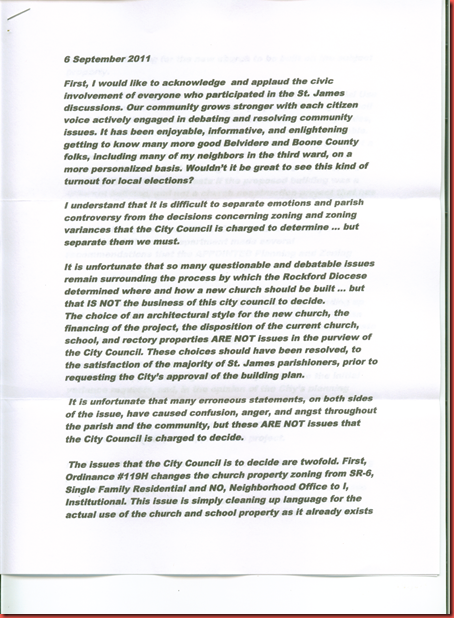
Chamberlain 1

Chamberlain 2

Chamberlain 3

St. James Campaign begins to post on parish website their “old” plan

UPDATE 9-9-2011:  The St. James Revised application is now available on the  parish website.  You may obtain it by following the directions described below.  All  of the parish’s architectural drawings are in black in white.  If you wish to see some of them in color go to my site:  http://boonecountycatholics.blogspot.com/2011/09/new-lower-height-design-of-st-

I previous reported that the campaign brochure was not available.  Now that brochure is available on the internet however it is describes the very oldest plans.  The church will hold 1,000 not 850 and the over seventy feet roof is shown.  To see the plans as approved for city zoning purposes (the 850 seat church and 64 foot church) go to:  http://boonecountycatholics.blogspot.com/2011/09/new-lower-height-design-of-st-

The following is taken from the Parish website:  http://www.stjamesbelvidere.org

imagejames.html

Note the campaign results are on this page to left.

image

Clicking on the bottom you reach the brochure plans.

Rockford Register Star coverage of the voting on St. James zoning

Click on the photocopy to enlarge: 

9-7-2011 RR Star

Here is the comments section from the on-line version of this story:  http://www.rrstar.com/news/yourtown/boone/x1638746876/St-James-prayers-for-new-Belvidere-church-answered-by-6-3-vote

Comments (3)


How did this get through all the committees and approved by the City Council? Planning and Zoning voted down a sign for Belvidere High School which has around 40 acres for a new sign because of the regulations but yet this is OK. It doesn't make sense to the average citizen.

westhighschoolalumna


What can be done to replace the space that would have been available in the basement of a new church? Will the stained glass windows and other antiques be salvaged from the old church? Could a multi-level parking garage be built on one of the lots to be used for parking so that more cars could fit into a given parking lot? What can be done to make those from other parts of Boone County besides Belvidere more welcome? Those and other questions parishioners or residents might have remain to be resolved. At least, however, the main issue of whether a replacement church can be built have been resolved.

JohnD123


A 5-6 story tall building in a residential neighborhood. Yup, that was a smart move. The planning and zoning commission guys are ignorant when it comes to the reasons behind zoning. Looks like it is made up of former city alderman. If the voters don't want you voting on issues at the City Council and they replace you, you can move to the Planning Commission and vote on things there. Chamberlain didn't want a religious organization moving across the street from him, but its okay in somebody else's neighborhood.
This was bad right from the start. If I were the neighbors I'd look for a good attorney. Those dunderheads within the City allowed something that violated so many building and zoning codes. That sets a precedent folks. If they aren't going to follow a code they adopted why the heck do they even have it?
And people wonder why Belvidere is dying?

BNNS Radio: Hear the Belvidere City Council Meeting regarding St James Zoning Decision

First of all click on the following and you will obtain the screen shown below:http://www.radiop1.com/mediacenter.aspx?stationid=16


image

Click on the second item as shown below, Belvidere City Council Meeting “Live”-9/6 6:55 PM –9:00PM


image

Monday, September 5, 2011

Rockford Register Star’s View: Downtown location best for new Belvidere church

Based upon the sparse coverage which Rockford Register Star has given to this issue, I find it incredible that the editors now  publish “their” opinion.  I find it annoying that no real issue such as height, size and parking are mentioned.  Is smart growth building a “cathedral style” colossus   in a residential neighbor casting shadows upon its neighbors.  Look at the words highlighted in green. Does the Register Star even know where the new church will be located?

It is interesting that perhaps for the first time,  the Bishop through his Director of Communication speaks of his intention.  I have highlighted that in yellow.

Mary Kaspar is the wife of Michael Kaspar, the paid bookkeeper of St. James Parish.

The following is taken from:  http://www.rrstar.com/insight/x1413010381/Our-View-Downtown-location-best-for-new-Belvidere-church


image

When does a church issue become a community issue? We think Belvidere Mayor Fred Brereton answered the question for us.
Brereton last week wrote a position paper on whether St. James Catholic Church should stay in downtown Belvidere and expand or build a new church on the edge of town on Squaw Prairie Road. He says the church staying downtown is a matter of smart growth and would be the best thing for the community. We agree.
While we’re uneasy about telling a church what to do, staying downtown appears to be the best thing for parishioners, too. In Belvidere, as in many urban communities, the growth is on the outskirts of town.
But downtown is where the need is. Churches, more than any other organization, should be about responding to need.
People in Belvidere are conflicted about St. James. One thing everyone agrees on, though, is the parish has outgrown its current building, which holds only 300 to 350 people.
Six services have to be held on Sundays to accommodate the crowds. The Spanish-speaking Masses are particularly popular; at those services, you can often find parishioners standing outside.
To even use the bathroom, parishioners have to leave the church and walk outside to another part of the building. Obviously, the situation is far from ideal for senior citizens as well as families with small children.
The Rockford Diocese, to which St. James belongs, has proposed a new church a few blocks away across from St. James School. It would accommodate about 850 people. St. James is the only Catholic church in Boone County.
Building the new church downtown at the proposed site requires the City Council to sign off on a zoning change from residential to institutional. The council will vote Tuesday, but the decision shouldn’t be difficult from a civic perspective.
The mayor has offered a strong argument for the rezoning through his position paper. He thinks the principles of smart growth make a downtown location the best choice for St. James. Smart growth goals include preserving open space and farmland, encouraging development where it already exists, and creating places people can walk to and not have to drive.
The 22-acre site at the western edge of town was donated by a parish family in 1998. The diocese “does not now have the intention to relocate the focus of the parish to the other property,” according to Penny Wiegert, the diocese’s director of communications.
“That would create more problems for the parish than it would solve.”
The church has much to celebrate. While other churches watch their congregations dwindle, St. James has a vibrant, committed, growing parish.
The fact so many people care about its fate is good news, not bad.
Much of the growth at St. James is in its Spanish-speaking and Hispanic parishioners. Many of these parishioners don’t have cars. They say it would be tough, if not impossible, to get to the Squaw Prairie site for regular worship.
Transportation is a consideration any community must take into account, but especially a church. Churches should be more committed than most organizations to providing for people of meager means.
As St. James parishioner Mary Kaspar wrote in the Register Star Aug. 19, “The bottom line is that we need a church where we can all worship God together.”
Building downtown is best for the bottom line.

Copyright 2011 Rockford Register Star. Some rights reserved

Sunday, September 4, 2011

The new “lower” height design of St. James church

Neither the parish nor its architect has posted the changes proposed to Belvidere City Council.  Thus only parishioners who attended the August 15 city council meeting or have been given a special showing are aware of the new design.

Here are the changes proposed—basically the building is now seven feet lower* and now closer to the parish center.


* Seventy feet was described previously as the height-- these photocopies speak of 72 feet as the original plans and 63 feet as the new height.  Note on both plans a cross  is on top of the roof still higher than these heights.

Brochure B-1

OLD

Brochure B-4

NEW

Brochure B-5

Brochure B-6

Brochure B-7

Brochure B-8

Brochure B-9

Brochure B-10

The new with handicapped spaces:

170 spaces w-ADA

Brochure B-11

Brochure B-12

Brochure B-13

Brochure B-14

Brochure B-15

Note the new design still has a cross almost as high as the old church and old church is that high only at the bell tower portion.  The old church’s peak is less than 50 feet.

Brochure B-16

Brochure B-17


New design is still eleven feet (nearly a story) higher than Alpine Bank-- when church’s peak is compared with bank’s flat roof. And remember there still is the added height of the cross no where is there mention of its height.  It appears to be 8 to 10 feet higher.

Brochure B-18

Without a bell tower the old designed, new church is taller than the old church.

Brochure B-19


Now with the new design the new church’s height equals the height of the old church at the top of the old church which atop the bell tower.


Brochure B-21


The 63 feet structure does not look so out of place with trees etc. in this view down Logan Ave.  Because several two story homes on the frame’s right,  the new 63 feet church appear no taller than these homes.


Brochure B Main


However now look what happens when the trees are erased (after all the trees around the convent will have to be cut down.) And your view is only of the structures near the new church.  The new church is twice the height of the gym at the parish center and because of distance from the school is nearly twice its height.

Brochure B   Main Touched